
Brand and lifestyle: building identity that connects
- Jeff Borchert

- May 27
- 8 min read

TL;DR:
Your brand and lifestyle are inseparable, with every visual touchpoint shaping your emotional signal.
Building loyalty requires creating an authentic, coherent emotional world, not just aesthetic mood boards.
Your brand and lifestyle are not two separate things to manage. They are one signal, and every photo, post, and visual touchpoint either makes that signal clearer or muddier. A lot of people treat lifestyle branding as a mood board exercise — pretty colours, a curated feed, maybe a new logo. But the brands that actually build loyalty go much deeper than aesthetics. They create an emotional world that people want to belong to. This article walks you through what that actually means, how to build it intentionally, and how strategic photography ties the whole thing together.
Table of Contents
Key takeaways
Point | Details |
Brand and lifestyle are inseparable | Your visual presence communicates your lifestyle values whether you plan it or not. |
Emotional alignment drives loyalty | 61% of Gen Z choose brands based on emotional resonance, not just product features. |
Systems beat individual assets | A coherent brand system creates scalability; a collection of isolated assets does not. |
Authenticity is not optional | Generic polished imagery builds less trust than real, process-driven storytelling. |
Photography is a strategic tool | Professional photos aligned to your brand values do more than look good — they communicate who you are. |
What lifestyle branding actually means today
Lifestyle branding is the practice of building a brand identity around a set of values, aesthetics, and experiences that reflect how your audience wants to live. It is not about selling a product. It is about selling belonging.
The concept has evolved significantly. Early lifestyle branding belonged to luxury houses and athletic giants. Today, it is accessible to solo entrepreneurs, small studios, and professional service firms alike. The shift happened because consumers stopped asking “what does this product do?” and started asking “does this brand get me?”
61% of Gen Z consumers choose brands based on emotional alignment, which tells you everything about where purchase decisions are being made. It is not in the features list. It is in the feeling. And that feeling is constructed through every visual, every caption, every environment your brand shows up in.
Here is what separates lifestyle brands that stick from ones that just look the part:
Shared values. The brand stands for something specific and consistently demonstrates it, not just on awareness days.
Community architecture. People feel like they are joining something when they follow or buy, not just subscribing to a feed.
Emotional coherence. Every touchpoint, from your LinkedIn headshot to your office environment, tells a consistent story.
Product and experience quality. Style without substance collapses. Lifestyle branding only works when backed by genuine product quality and customer experience.
“Successful lifestyle brands blend approachability with cultural authority, balancing aspirational and relatable elements.” — Branded Agency case study
Leading brands that do this well are forecasted to achieve up to 3.5x growth by 2028 through direct-to-consumer channels and lifestyle ecosystem expansion. That is not a coincidence. It is the compound result of emotional investment from audiences who feel seen.
Brand assets vs. brand systems
Here is a distinction that changes how you build: there is a massive difference between having brand assets and having a brand system.
Brand assets are the outputs. Your logo, your headshots, your brand photography, your colour palette. Brand systems are the rules and logic that govern how all those assets work together and continue to work together even when you are not in the room.

Designing brand rules instead of individual assets creates scalability and coherence that holds even when the original designer or founder is not involved. That is the goal. A brand system means your imagery, your messaging, and your visual tone all feel like they came from the same place, because they did.
Brand assets | Brand system | |
What it includes | Logo, photos, colour palette, fonts | Rules for how all assets work together |
Scalability | Low — individual pieces drift over time | High — coherent across every touchpoint |
Who can use it | Typically the creator or designer | Anyone on your team, across any medium |
Long-term value | Depreciates without guidance | Appreciates as the brand grows |
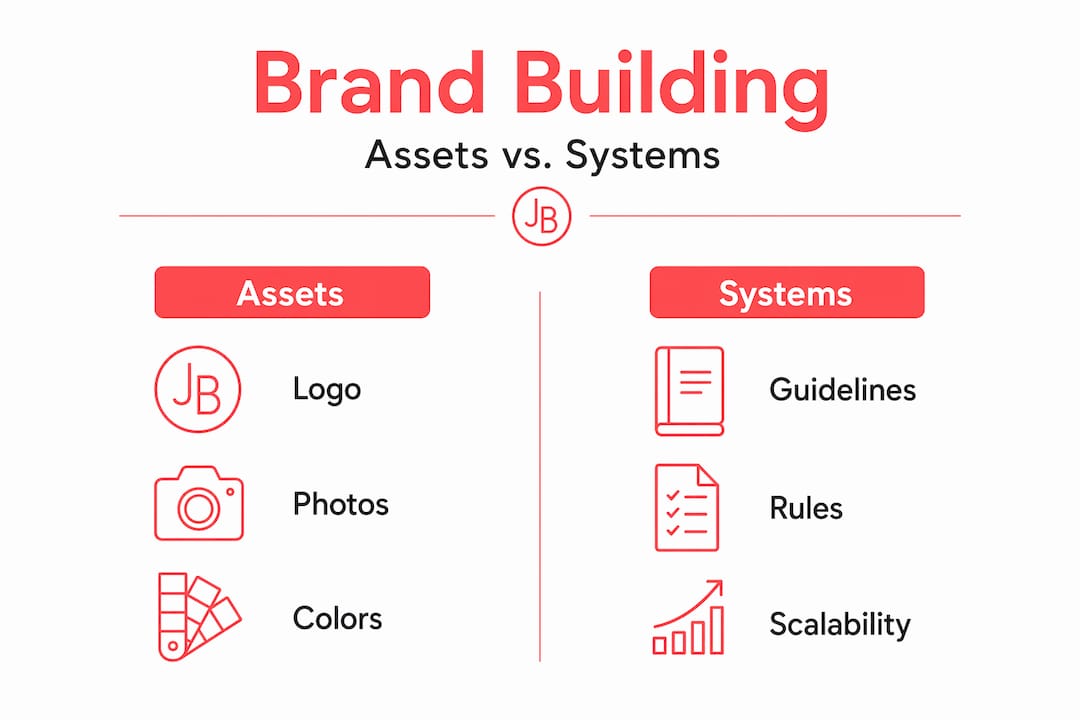
Photography fits into both layers. A great headshot is an asset. A photography style guide that tells your team how to frame, light, and present your people consistently? That is part of your system. Brand identity and image alignment happens when the gap between how you see yourself and how your audience sees you narrows through consistent visual expression.
Pro Tip: Ask yourself: if a new team member joined tomorrow, could they look at your visual guidelines and produce something that feels like your brand? If not, you have assets but not a system.
Professional photography plays a direct role in strengthening your system. When your visual brand identity is built around deliberate imagery choices rather than stock photos and casual iPhone snaps, every piece of content carries the same energy and intention.
Applying lifestyle branding to your own brand
Whether you are a solo consultant or leading a 40-person firm, the same principles apply. The difference is in the scale and who is at the centre.
Personal brand vs. business brand decisions affect scalability, authenticity, and the long-term value of what you are building. A personal brand anchored entirely in the founder’s face and personality can grow quickly, but it can also hit a ceiling. A business brand with a strong identity system can outlast any individual’s involvement.
Here is a practical approach to building a lifestyle brand that actually reflects who you are:
Clarify your core values. Not the words on your wall. The values that actually show up in how you work, who you hire, and what you say no to. Write three sentences about each one.
Define your brand’s lifestyle promise. What world does your brand invite people into? What do they feel when they engage with you? Be specific — “professional and reliable” is not a lifestyle. “Confident, seen, and ready to show up” is.
Audit your current visual presence. Look at your website, LinkedIn profile, and marketing materials as a stranger would. Does the imagery match the lifestyle promise you just wrote? Most of the time, there is a gap.
Build visual consistency across every touchpoint. Your headshots, team photos, event imagery, and social content should feel like they are from the same world.
Tell stories, not just announcements. Share the process, the people behind the work, and the real moments. Authentic origin stories and visible creation processes build trust far more effectively than polished launch announcements.
Then there are the habits that sustain it:
Show up consistently, not just when you have something to sell.
Use real environments that reflect your actual work culture, not rented spaces that look nothing like you.
Involve your team in the visual story. Brands built only on the founder’s image are fragile.
Photography’s role in your brand and lifestyle
This is where strategy meets execution. You can have all the right values and the best brand system in the world, and if your photography does not reflect it, you will lose people in the first three seconds of looking at your website.
Professional photography is not about vanity. It is about removing friction. When someone lands on your LinkedIn profile or company website, a great photo signals competence, warmth, and credibility before a single word is read. That is the impact of professional photography on your first impression.
Here is how to plan photography that actually serves your brand and lifestyle:
Align your shoot environment with your brand values. A creative agency might shoot in a colourful studio. A financial firm might use clean, natural light. Neither is right or wrong; both are intentional.
Capture candid and process moments, not just posed portraits. Behind-the-scenes content builds deeper consumer trust than polished campaign images alone. Show your team in motion, your workspace in use, your process as it actually happens.
Plan for multiple touchpoints in one session. A single well-planned shoot can produce your LinkedIn headshot, website hero images, social content, and event preview materials. Think ahead.
Keep your team’s photos consistent. When every person on your team has a headshot with different lighting, different backgrounds, and different energy, it fragments the brand. Consistency signals organisation and care.
Pro Tip: Before your next photo session, write down three words that describe how you want people to feel when they see your brand. Share those words with your photographer. That brief changes everything about what you walk away with.
Lifestyle branding photography is not a single hero shot. It is a library of images that works together to tell an ongoing story, from your headshots to your team culture shots to the candid moments from your events.
My honest take on building a lifestyle brand
I have photographed a lot of brands at different stages, from scrappy startups to established Calgary firms. And the pattern I keep seeing is the same: people invest in great photos, then go back to inconsistency everywhere else. The photos do their job; the rest of the brand does not.
The most durable lifestyle brands I have seen are not built around the founder being everywhere. They are built around a strong product, customer experience, and community that would hold up if the founder stepped back tomorrow. That takes real intention.
What I have also noticed is that the brands people remember are not the most perfectly styled ones. They are the most consistently honest ones. The ones that show the real workspace, the real team, the real process. That is what live events and behind-the-scenes moments give you that no polished campaign ever can.
My advice: stop waiting until your brand is “ready” to invest in photography. The photos are part of what makes it ready. Show up, be specific about who you are, and let the imagery do the heavy lifting it was always meant to do.
— Jeff
Bring your brand to life with professional photography
If you have been nodding along and realising your current photos do not match the brand you are building, that is actually a great place to be. It means you know what needs to change.
[
At Itsjeffb, we work with Calgary professionals, entrepreneurs, and teams to create photography that genuinely reflects who they are and where they are headed. Whether you need a clean, confident personal headshot or a full set of team photos that bring your company culture to life, the process is designed to be guided, low-stress, and outcome-focused. You will walk away with images you are proud to put in front of people, not ones you hide in a folder.
Check out our photography pricing and packages to find the right fit for your brand goals. Let’s make sure your visual story is actually telling the story you want told!
FAQ
What is the difference between brand identity and lifestyle branding?
Brand identity is the full system of how your brand presents itself visually and verbally. Lifestyle branding is a strategy that anchors your brand to the values and experiences your audience aspires to, making the brand part of how they see themselves.
How does photography support lifestyle branding?
Photography communicates your brand’s personality, values, and culture instantly. Consistent, intentional imagery across your website, LinkedIn, and marketing materials tells a coherent story that resonates emotionally with your audience.
Can small businesses or solo professionals build a lifestyle brand?
Absolutely. Lifestyle branding is not reserved for large companies. Solo professionals and small teams can build powerful lifestyle brands by being clear on their values, showing up consistently, and using authentic photography that reflects their real work and personality.
How do I know if my brand photos are working for my brand?
Ask yourself whether a stranger looking at your photos alone could understand what your brand stands for and how it would feel to work with you. If the answer is no, your photos are not doing their strategic job yet.
Why does consistency in brand photography matter so much?
When your visual content is inconsistent, even great individual photos undermine your brand. Consistency signals professionalism and builds the kind of familiarity that turns casual visitors into loyal clients.
Recommended


Comments