
Business photo guide: types, tips, and best practices
- Jeff Borchert
- Jun 27
- 9 min read
TL;DR:
Business photography uses professional images to showcase a company’s brand, people, and culture across various channels. A business photo guide helps plan, identify, and consistently use images aligned with specific marketing and recruitment goals.
Business photography is the practice of using professional images to represent a company’s brand, people, and culture across marketing, recruitment, and sales channels. A solid business photo guide helps you understand which types of images you need, how to plan for them, and why the quality of those images directly shapes how clients, candidates, and partners perceive your company. Whether you run a solo consultancy in Calgary or manage a team of fifty, the right photos build trust before anyone reads a single word on your website. Itsjeffb works with businesses of all sizes to create clean, natural imagery that shows up with confidence on LinkedIn, websites, and print materials. Updating your photos every 1–2 years is the recommended industry standard to maintain credibility.
What is a business photo guide and why does it matter?
A business photo guide is a structured reference that defines which types of professional images a company needs, how to plan and prepare for a shoot, and how to use the resulting images across channels. Think of it as a creative brief and a checklist rolled into one. Without this kind of structure, businesses end up with a scattered mix of photos that feel inconsistent and fail to tell a clear story.
The business case is straightforward. Clients form first impressions within seconds of landing on your website or LinkedIn profile. Authentic, well-lit, professionally composed images signal that your company is credible and worth trusting. Generic stock photos do the opposite. Successful brand photography focuses on clarity, cohesion, and connection rather than perfect poses to build authentic trust.
Professional imagery also supports recruitment. Candidates research companies before applying, and workplace photos, team shots, and culture images give them a genuine sense of what it feels like to work there. A company that invests in its visual identity signals that it values its people and its reputation.
What are the common types of business photography?
Business photography covers several distinct categories, and each one serves a different purpose. Knowing which type you need is the first step in building a useful photo library.
Professional headshots. A headshot is the most personal business photo. It puts a face to a name on LinkedIn, email signatures, speaker bios, and company websites. A great headshot communicates confidence and approachability at the same time. These are the highest-priority images for entrepreneurs, executives, and client-facing professionals.
Team photos. Group shots show the people behind the brand. They work well on About pages, recruitment materials, and internal communications. Cohesive team photos, where everyone is lit and styled consistently, signal a well-organised company. Inconsistent team photos (some formal, some casual, some blurry) do the opposite.
Branding photography. This category captures the personality and environment of a business. It includes images of your workspace, your products, your tools, and the moments that define how you work. Branding photos are the backbone of social media content, website headers, and marketing campaigns.
Workplace and culture photos. These images show your office, studio, or job site in action. They are particularly valuable for recruitment because they give candidates a real sense of the environment. A well-lit, clutter-free workspace photograph communicates professionalism without a single word.
Event and conference coverage. Corporate events, product launches, and team gatherings generate moments worth capturing. Event photos document milestones, create content for social media, and reinforce brand momentum. Itsjeffb offers next-day highlight images from events so businesses can post while the energy is still fresh.
Website and social media content. This is a catch-all category for images designed specifically for digital use. Horizontal banners, square crops for Instagram, and vertical portraits for LinkedIn Stories all require intentional composition from the start.
Pro Tip: Build your shot list by channel first. Write down every place you plan to use photos (website hero, LinkedIn banner, Instagram grid, print brochure) and then work backwards to identify which images you actually need.

How does professional photography impact marketing, branding, and recruitment?
Professional photography does more than make a website look polished. It shapes how people feel about your business before they ever speak to you. That emotional first impression is a marketing asset with real commercial value.
Here is where the impact shows up most clearly:
Trust and credibility. Consistent, high-quality images across your website, social media, and printed materials signal that your business is established and reliable. Mismatched or outdated photos create doubt.
Competitive differentiation. In crowded markets, visual identity is one of the fastest ways to stand out. A Calgary professional services firm with genuine, well-composed imagery looks more credible than a competitor relying on stock photos.
Recruitment appeal. Candidates evaluate companies visually. Workplace photos and team images give candidates a feel for culture that a job description simply cannot convey.
Social media performance. Original photography consistently outperforms stock imagery in engagement. Authentic images of real people and real spaces connect with audiences in a way that staged, generic photos do not.
The role of professional photography for brands goes well beyond aesthetics. It is a direct investment in how your company is perceived at every touchpoint.
What are the best practices for planning a business photoshoot?
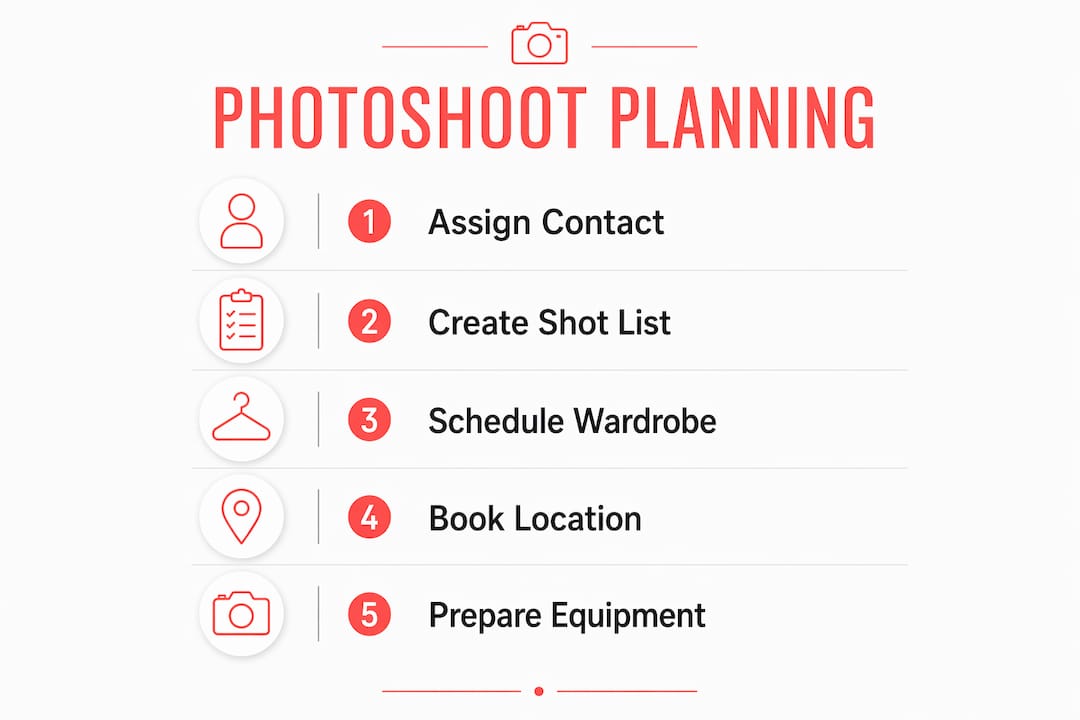
Planning is where most businesses either win or lose their photoshoot. Photography accounts for roughly 30% of the project’s value. The remaining 70% is pre-production: shot lists, wardrobe decisions, location prep, and clear communication with your team. Treat the shoot like a mission briefing, not a casual appointment.
Here is a practical planning sequence:
Define your use cases first. Before booking anything, list every channel and format where you plan to use the images. A LinkedIn banner needs a different crop than a website hero image. Knowing this upfront shapes every other decision.
Build a shot list. A shot list is a written inventory of every image you need. It includes the subject, the setting, the mood, and the intended use. This document guides the photographer and keeps the session on track.
Give your team at least 2 weeks’ notice. Informing team members 2 weeks in advance improves cooperation and preparation. People need time to arrange their wardrobe, schedule the time, and mentally prepare.
Send wardrobe guidelines early. Wardrobe guidance should go out at least 1 week before the shoot. Consistent clothing choices across a team create visual cohesion in group and individual shots.
Prepare the environment. Clearing clutter and choosing appropriate backgrounds before the shoot significantly improves final image quality. Distracting backgrounds are difficult to fix in post-production.
Schedule buffer time. Headshot sessions require 10–15 minutes per person for quality results. Build in breaks between subjects to maintain natural expressions and energy throughout the day.
Create a photography style guide. A formal photography style guide establishes consistent tonal palettes, cropping rules, and composition standards. This makes images taken across different dates and locations feel like they belong to the same brand.
Pro Tip: Assign one person on your team as the internal point of contact for the shoot. They handle scheduling, wardrobe reminders, and location logistics so the photographer can focus entirely on capturing great images.
Planning element | Why it matters |
Shot list | Prevents missed images and keeps the session efficient |
2-week team notice | Improves preparation and reduces last-minute cancellations |
Wardrobe guidelines | Creates visual cohesion across individual and group shots |
Environment prep | Removes distractions that are costly to fix after the shoot |
Photography style guide | Keeps images consistent across time, locations, and channels |
Which types of business photography suit your goals?
The right photo mix depends on your business size, industry, and where you are in your growth. Not every business needs every type of image right away.
Small businesses and entrepreneurs should prioritise headshots and branding photography first. A strong personal headshot builds trust on LinkedIn and your website immediately. Branding images that show your workspace, tools, and process give clients a sense of who you are and how you work. These two categories deliver the highest return for solo operators and small teams.
Corporate teams benefit most from cohesive team photos and workplace environment imagery. When every team member has a consistent, professionally lit headshot, the company’s About page looks organised and credible. Workplace photos support both marketing and recruitment by showing the culture in action. Itsjeffb specialises in on-location team headshots that deliver consistent results across entire groups without pulling people off-site for hours.
Service businesses (law firms, consultancies, financial advisers) rely heavily on headshots and team photos because the people are the product. Clients are hiring a person, not just a company. Strong personal imagery is non-negotiable in these industries.
Product companies need branding and product photography that shows their goods in context. Lifestyle images of products in use outperform plain white-background shots for social media and website content.
Here is a quick reference for matching photo types to common goals:
Business goal | Recommended photo types |
Build personal credibility | Professional headshots |
Showcase company culture | Team photos, workplace images |
Support social media content | Branding photography, event coverage |
Attract job candidates | Workplace and culture photos |
Launch a new product or service | Branding photography, event coverage |
For Calgary businesses specifically, branding photography creates a visual identity that resonates with local audiences and stands out in a competitive market.
Key takeaways
A business photo guide is most effective when it connects specific image types to specific business goals, backed by deliberate pre-production planning.
Point | Details |
Define image types by purpose | Match headshots, team photos, and branding images to your marketing, recruiting, and sales goals. |
Plan before you shoot | Shot lists, wardrobe guidelines, and environment prep determine final image quality more than the shoot itself. |
Update photos regularly | Refresh your professional images every 1–2 years or after significant brand changes to stay credible. |
Use a style guide | A photography style guide keeps images consistent across channels, dates, and locations. |
Match photo type to business size | Small businesses prioritise headshots; corporate teams benefit most from cohesive group and workplace imagery. |
What I’ve learned about business photography after years behind the lens
The biggest mistake I see businesses make is treating a photoshoot as a one-day event rather than a planned production. They book a photographer, show up with no shot list, and hope for the best. The results are usually fine but rarely great. Fine photos do not build trust. Great photos do.
The second mistake is underestimating how much the environment shapes the final image. Lighting and setting are just as important as how the subject looks. A beautifully dressed executive photographed in a cluttered, poorly lit boardroom will still produce a mediocre headshot. The space tells half the story.
What I find genuinely exciting is when a business owner arrives with a clear sense of what they need and where they plan to use it. That clarity turns a photoshoot into a content production session. We leave with images for the website, LinkedIn, the team page, and three months of social media content. That is the multiplier effect of good planning.
Authenticity matters more than perfection. The best business photography tips I can offer come down to this: show up as you actually are, in a space that reflects how you actually work, and let the images tell a true story. Clients connect with real. They scroll past staged.
— Jeff
Professional business photography in Calgary with Itsjeffb
Calgary businesses that are ready to build a stronger visual identity have a local partner in Itsjeffb. Whether you need individual headshots, a full team session, or branding imagery for your website and social media, the process is designed to be guided, efficient, and stress-free.
[
Itsjeffb offers on-location team headshots that deliver consistent results across your entire group without pulling everyone off-site. Branding sessions are built around your actual workspace and story, not a generic studio backdrop. Every session starts with a clear plan so you leave with images you are proud to use right away. Check out photography pricing and packages to find the right fit for your business goals and budget.
FAQ
What is a business photo guide?
A business photo guide is a structured plan that defines which types of professional images a company needs, how to prepare for a shoot, and how to use the resulting images across marketing and recruitment channels.
How often should businesses update their professional photos?
Businesses should update professional photos every 1–2 years or after significant brand changes, such as a rebrand, office move, or major team expansion.
How long does a business headshot session take?
A headshot session requires 10–15 minutes per person for quality results. Buffer time and breaks between subjects help maintain natural expressions throughout the day.
What types of business photos do small businesses need most?
Small businesses and entrepreneurs benefit most from professional headshots and branding photography, as these two categories build personal credibility and communicate brand personality most effectively.
What is a photography style guide and do I need one?
A photography style guide sets consistent rules for tonal palettes, cropping, and composition across all your business images. It is particularly valuable for companies that shoot across multiple locations or update their photo library over time.
Recommended


Comments