Explaining branding for businesses: what it really means


TL;DR:
Branding is a strategic process that shapes customer perception through messaging, visual identity, and experience. Consistent, professional photography reinforces trust and credibility, supporting long-term loyalty. A well-defined brand reduces marketing costs and increases resilience during economic fluctuations.
Branding is defined as the strategic process of shaping how your business is perceived across every customer interaction, from your logo to your language to the experience you deliver. Explaining branding for businesses means going well beyond colours and fonts. It includes your reputation, your messaging, the feelings customers associate with your name, and the consistency with which you show up. About 80% of consumers trust brands they use, and 68% are willing to pay more for those trusted brands. For small to mid-sized businesses, that trust is not a luxury. It is the difference between competing on price and competing on value.
What does a business brand actually include?
Brand identity is not just a logo. It is a system made up of four interconnected parts: positioning, messaging, visual identity, and experience. Each one shapes how customers understand and remember you.

Positioning defines where your business sits in the market and why you are the right choice for a specific customer. Messaging is the language you use to communicate your value, and aligning that language with how customers already speak is more effective than clever slogans or corporate jargon. Visual identity covers your logo, colour palette, typography, and photography. Experience is everything a customer feels when they interact with your business, from your website to your team’s tone on a phone call.
The distinction between brand assets and brand strategy matters here. Brand assets are the tangible outputs: the logo file, the brand colours, the headshot on your website. Brand strategy is the thinking behind those assets. It answers who you serve, what you stand for, and why that matters. A business brand should exist independently of the founder, which means the strategy must be documented and transferable, not just in the founder’s head.
Positioning: Who you serve, what problem you solve, and why you are the right choice
Messaging: The words, tone, and promises you make consistently across every channel
Visual identity: Logo, colours, typography, photography, and design system
Experience: How customers feel at every touchpoint, from first click to follow-up email
Pro Tip: Write your brand positioning in one sentence before you design anything. “We help [audience] achieve [outcome] by [method]” is a simple template that forces clarity and prevents expensive design detours.
Why does strong branding matter for small businesses?
Strong branding directly changes customer behaviour. 37% of business owners cite marketing as their greatest challenge, and a clear brand identity reduces that burden by doing much of the persuasion work before a sales conversation even begins.
“Effective branding clarifies your audience, your positioning, your promise, and your values. It builds trust and consistency across every customer interaction. Without that clarity, every marketing dollar works harder than it needs to.”
When customers recognise and trust your brand, they require less convincing. That means fewer discounts, shorter sales cycles, and lower acquisition costs over time. A business that competes on brand equity does not need to compete on price. For small businesses in particular, that is a meaningful competitive advantage against larger players with bigger advertising budgets.
Brand equity is an intangible asset that creates resilience during economic uncertainty. Customers who feel connected to a brand are less likely to switch when a competitor offers a lower price. That emotional loyalty is built through consistent experience and coherent messaging, not through one-off promotions. The businesses that weather slow periods best are usually the ones whose customers feel a genuine connection to what the brand represents.
How does professional photography build brand trust?
Photography is one of the most immediate signals of professionalism a business sends. Before a prospect reads a single word on your website, they have already formed an impression based on the images they see. Professional photography is a vital visual element that builds consistent brand identity and elevates perceived credibility among clients and prospects.
For Calgary entrepreneurs and small business teams, this is especially relevant. A blurry phone photo on a LinkedIn profile or a mismatched collection of team headshots on a company website quietly undermines the trust that all your other branding efforts are trying to build. Consistent, high-quality imagery signals that your business pays attention to detail. That signal carries weight with clients who are deciding whether to trust you with their money.
A strong brand identity communicates professionalism and trustworthiness, and photography is one of the fastest ways to communicate both. The visual consistency across your headshots, team photos, and event images tells a story about who you are before anyone speaks to you.
Use the same lighting style and background across all team headshots for visual consistency
Update headshots whenever your team changes significantly, so your website reflects your actual team
Choose photography that matches your brand’s tone: warm and approachable, or clean and corporate
Use branding photography for website banners, social media, and pitch decks, not just your “About” page
Pro Tip: Book your team headshots on the same day with the same photographer. Consistency across the full team is far more powerful than individual photos taken at different times and locations.
What is the step-by-step process for building a brand?
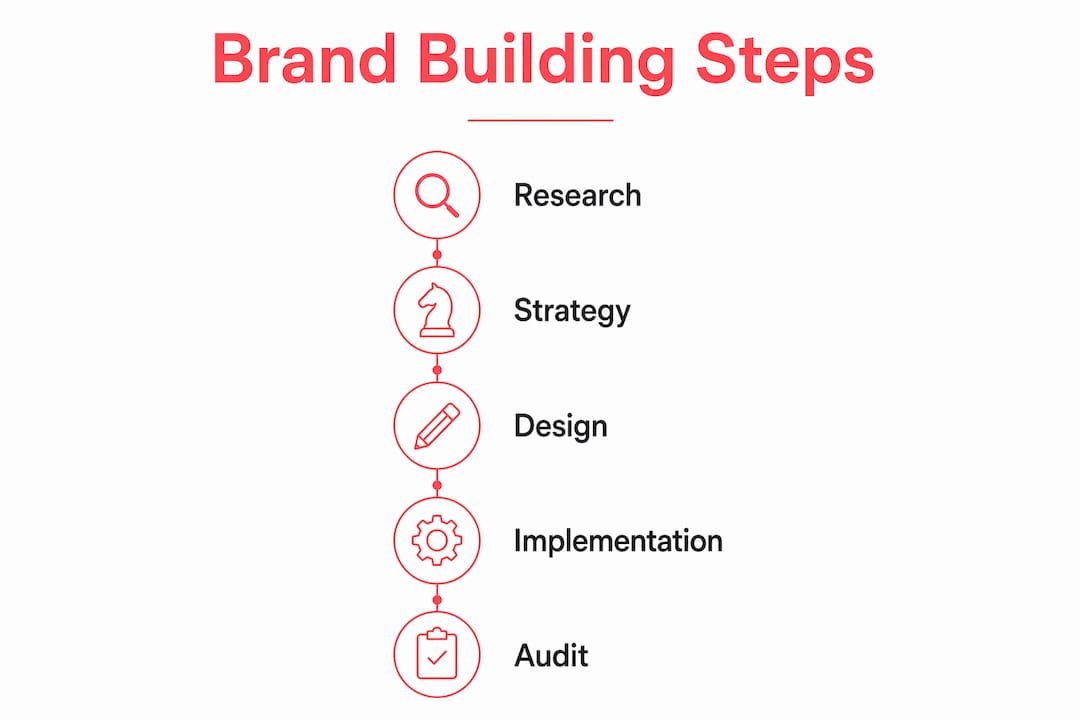
A 9-step branding process gives businesses a clear path from research to consistent application. Skipping steps, especially the early strategic ones, is the most common and costly mistake small businesses make.
Market research: Understand your customers, your competitors, and the gap you fill
Brand personality: Define the human traits your brand embodies (reliable, bold, warm, precise)
Naming: Choose a name that is clear, memorable, and searchable
Slogan: Write a short phrase that captures your promise, not your features
Visual identity: Select colours, typography, and imagery that reflect your personality
Logo design: Create a mark that works across all sizes and formats
Brand assets: Build a library of templates, icons, and photography
Brand guidelines: Document every rule so your brand stays consistent as your team grows
Consistent application: Apply your brand across every touchpoint without exception
Starting with logo design before defining strategy results in disjointed visuals and expensive rebrands. The logo is step six, not step one. That ordering is not arbitrary. Every visual decision should flow from the strategy you built in steps one through four.
Branding stage | Common mistake | Better approach |
Research | Skipping it to save time | Interview 5–10 real customers about their language and priorities |
Positioning | Being too broad (“we serve everyone”) | Define one primary audience and own that space |
Visual identity | Choosing colours you personally like | Choose colours that match your brand personality and industry context |
Photography | Using phone photos to save money | Invest in one professional session and use those images across all channels |
Application | Applying brand guidelines inconsistently | Create a one-page brand reference sheet your whole team can use |
Pro Tip: Run a quick brand audit once a year. Pull up your website, your LinkedIn profile, your email signature, and your latest proposal. If they do not look and sound like the same business, your brand has drifted.
Your physical environment is also part of the brand experience. The role of your office environment in brand perception is often overlooked, but clients notice the details of your space just as they notice your photography and messaging.
How does branding support recruiting, sales, and loyalty?
Branding does not stop at marketing. Branding supports recruiting by attracting staff aligned with company values and helps sales by building buyer confidence before the first conversation. A business with a clear, consistent brand attracts people who already believe in what it stands for.
Recruiting: Candidates research companies before applying. A coherent brand with clear values and professional imagery signals a well-run organisation worth joining.
Sales: Prospects who recognise your brand arrive with more trust. That trust shortens the sales cycle and reduces the need for heavy discounting.
Customer loyalty: Consistent experience across every touchpoint creates emotional connection. Customers who feel connected to your brand refer others and return without needing a promotion to prompt them.
Internal alignment: A documented brand gives your team a shared language and standard. Everyone knows what “on brand” means, which reduces inconsistency as you grow.
Branding is an ongoing process requiring consistent delivery across all touchpoints to build mental availability and trust. That consistency is what makes a brand feel reliable. Reliability is what makes customers choose you again. For small businesses building a reputation in a specific market, like Calgary’s professional services sector, that reliability compounds over time into something genuinely valuable.
A well-built brand also makes your business more transferable. Business brands should exist independently of the founder, allowing growth, team-building, and eventual sale of the company. If your brand is entirely tied to your personal reputation, it cannot outlast you. Building a brand that stands on its own is one of the most valuable things a business owner can do.
For businesses that also want their digital presence to reflect their brand, professional website design plays a similar role to photography: it either reinforces or undermines the trust your brand is working to build.
Key takeaways
Strong branding is a documented, consistent system that shapes customer perception, builds trust, and reduces the cost of growing a business over time.
Point | Details |
Branding is a system, not a logo | It includes positioning, messaging, visual identity, and experience working together. |
Strategy comes before design | Define your audience and positioning before creating any visual assets. |
Photography signals credibility | Consistent, professional imagery builds trust faster than any written claim. |
Branding extends beyond marketing | A clear brand supports recruiting, sales cycles, and long-term customer loyalty. |
Consistency is the active ingredient | Applying your brand the same way across every touchpoint is what makes it work. |
What I have learned from watching small businesses brand themselves
Most small business owners I work with come to me thinking they need better photos. What they actually need is a clearer brand. The photos are just the moment that makes the gap visible.
The most common mistake I see is treating the logo as the brand. A business owner spends weeks choosing a font and a colour, then launches with no clear message, no positioning, and no consistency across their channels. Six months later, nothing has changed, and they blame the logo. The logo was never the problem.
What actually moves the needle is clarity. When a business knows exactly who it serves, what it promises, and how it wants to be perceived, every other decision becomes easier. The photography session becomes purposeful. The website copy writes itself. The sales conversation gets shorter.
I also think small business owners underestimate how much their visual identity is doing (or failing to do) on their behalf every single day. Your headshot on LinkedIn, your team photo on your website, the images in your proposals: these are working without you. They are either building trust or quietly eroding it. That is why I care so much about getting the photos right. It is not vanity. It is brand infrastructure.
The best brands I have seen from small Calgary businesses are not the flashiest ones. They are the most consistent ones. Same tone, same look, same promise, every time. That consistency is what customers remember, and what they come back for.
— Jeff
Professional branding photography for Calgary businesses
Your brand strategy deserves visuals that match it. At Itsjeffb, we work with Calgary businesses and entrepreneurs to create clean, professional photography that fits naturally into your brand identity, whether that is individual headshots, full team sessions, or branded imagery for your website and marketing materials.
[
Every session is guided and straightforward, even if you are not comfortable in front of a camera. The goal is always photos you are genuinely proud to use. Check out session pricing and options to find the right fit for your business, or explore team headshot sessions if you are looking to bring consistency across your whole crew.
FAQ
What is branding for a business?
Branding is the strategic process of shaping how a business is perceived through consistent messaging, visual identity, and customer experience. It includes everything from your logo and photography to the tone of your emails and the values you communicate publicly.
Why is consistent branding important for small businesses?
Consistent branding builds trust, reduces customer acquisition costs, and creates emotional loyalty that keeps customers returning. Businesses with coherent, consistent brands compete on value rather than price.
What should come first in a branding process?
Strategy always comes before design. Define your target audience, positioning, and core promise before creating any visual assets, including your logo. Starting with the logo before the strategy leads to costly rebrands.
How does photography fit into a business brand?
Photography is a core visual identity component that signals professionalism and credibility at a glance. Consistent, high-quality headshots and team images reinforce your brand’s tone and build trust before a prospect reads a single word.
Can branding help with recruiting and sales, not just marketing?
Yes. A clear, consistent brand attracts job candidates who align with your values and gives prospects confidence before the first sales conversation. Strong brands shorten sales cycles and reduce the need for discounting.
Recommended

Comments