What is branding for teams: a manager's guide


TL;DR:
Effective team branding encompasses values, culture, messaging, and visuals that shape how your team appears and operates internally and externally.
Clarity, internal alignment, and consistent application across tools and touchpoints are essential for building a strong, lasting team identity.
Most team leaders think branding stops at the logo. Pick a colour, design a badge, print some business cards, and you’re done. But that thinking leaves enormous value on the table. What is branding for teams, really? It’s the full system of identity that shapes how your people show up, how they work together, and how the world perceives you. It covers values, behaviours, messaging, and visuals, all working together. Get it right, and your team becomes recognisable, cohesive, and magnetic. Get it wrong, and you’re just a group of people with matching shirts.
Table of Contents
Key takeaways
Point | Details |
Branding goes beyond visuals | Team branding includes culture, values, messaging, and daily behaviours, not just logos and colours. |
Internal alignment drives results | When your team lives the brand from the inside, external perception takes care of itself. |
Consistency builds trust | 62% of consumers pay more for brands with a consistent, compelling story. |
Tools make it sustainable | Embedding brand assets into daily tools like Figma creates a living system, not a static folder. |
Speed comes from clarity | Agile branding methods can deliver premium results in under three weeks when purpose is clear. |
What team branding really means
Team branding is not a one-time project. It’s the ongoing, living identity of your group, built from the inside out.
Think of it in layers. The deepest layer is culture: the values your team holds, the mission driving your work, and the everyday behaviours that reflect both. Above that sits messaging and storytelling, which is how you talk about who you are and what you do. And on top of that is the visual identity layer, the logos, colours, apparel, and design that make your team instantly recognisable.
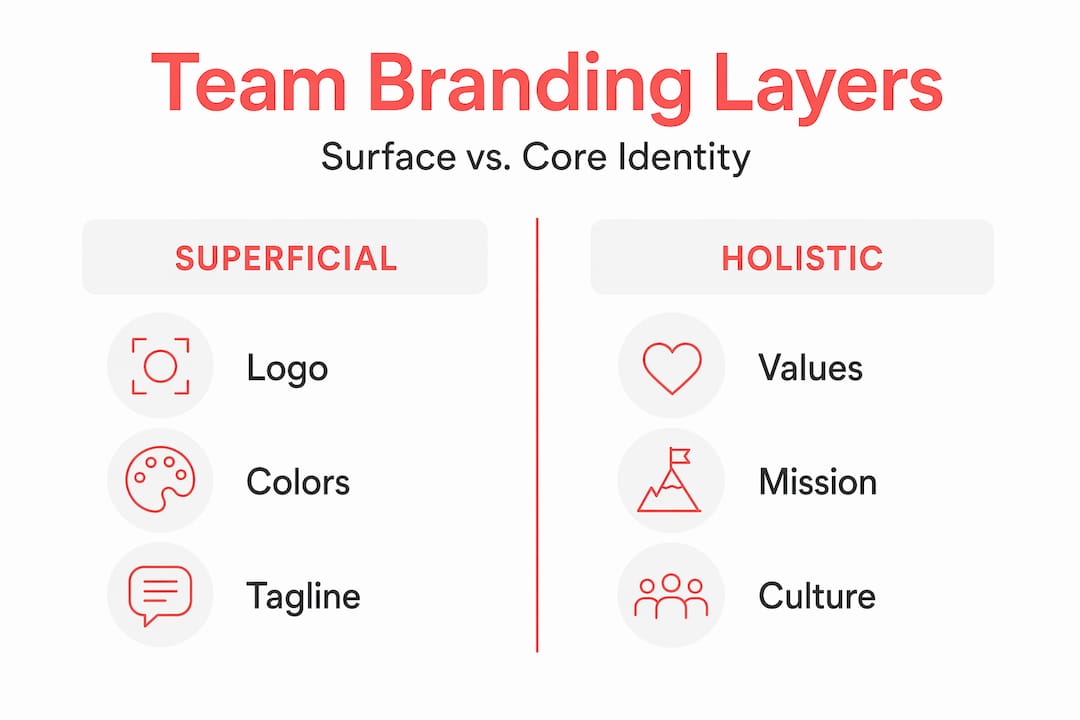
Here’s what separates a superficial brand from a genuinely powerful one:
Aspect | Superficial branding | Holistic branding |
Visual identity | Logo and colour palette | Consistent visuals applied across all touchpoints |
Culture | Unspoken or ignored | Actively defined, shared, and reinforced |
Messaging | Informal and inconsistent | Clear narrative used internally and externally |
Community engagement | Rare or accidental | Intentional and tied to brand values |
Employee experience | Disconnected from brand | Employees understand and embody the brand |
Community engagement also plays a bigger role than most managers expect. The teams that show up at industry events, sponsor local initiatives, or contribute to their professional communities build an external reputation that amplifies their internal identity. That external visibility reinforces the internal story, and vice versa.
Winning team brands align brand culture with hiring and retention, so that every new person added to the team reinforces the identity rather than diluting it. That is brand culture in action.
Why branding matters for your team
The importance of branding for teams goes well beyond aesthetics. Strong branding is a performance advantage.
Here’s what the research and real-world results show:
Customer trust and revenue. 62% of consumers will pay more for brands with a consistent, compelling story. If your team is client-facing, this is not a marketing statistic. It’s a revenue number.
Internal cohesion. Coordinated visual signals like matching apparel and consistent meeting themes reinforce equality, professionalism, and belonging across a group. People perform better when they feel part of something.
Employee retention. When employees understand and believe in the brand they represent, they stay longer and perform more consistently. Brand clarity reduces ambiguity, and ambiguity is exhausting.
Client perception. A team with a cohesive identity projects confidence. Clients notice. New business follows.
Think of your team brand as an operating system, the infrastructure beneath everything you do. Clarity and alignment in that system allow teams to move quickly, adapt to change, and maintain quality even under pressure. Without it, every project starts from scratch culturally.
Pro Tip: Coordinate even small visual details across your team, like consistent backgrounds on video calls or branded slide templates. These micro-signals accumulate quickly and reinforce a professional, cohesive culture without requiring a big budget.

How to build your team branding strategy
Effective team branding is built in deliberate steps. Here’s how to brand a team with real staying power:
Clarify your vision, mission, and values together. Don’t hand your team a document. Hold a working session. Ask what you stand for, what you’re building toward, and how you want to be known. The act of building this together creates buy-in that no memo can manufacture.
Develop your visual identity. Choose colours, fonts, and imagery that reflect your team’s character. Apply them consistently across every touchpoint: proposals, presentations, social profiles, email signatures, and physical materials. Inconsistency is the silent killer of brand credibility.
Create a messaging framework. How does your team describe what it does? What language do you use? A short, shared vocabulary for your work makes every team member a confident, consistent ambassador.
Embed brand assets into daily tools. Living asset libraries in tools like Figma prevent branding breakdown and make consistent application automatic rather than effortful. When the right logo is always one click away, people use it.
Appoint brand ambassadors. 1 to 2 brand ambassadors per team help sustain consistency, manage transitions, and keep the brand alive during periods of growth or change. These are not design police. They’re culture carriers.
Apply branding across internal and external touchpoints equally. Your brand is not just what clients see. It’s how your team room looks, how meetings feel, and how onboarding is designed. The internal experience shapes the external delivery.
Pro Tip: Use agile branding methods to avoid analysis paralysis. Premium branding updates can be delivered in under three weeks when your team has clarity and alignment upfront. Start with your core values and work outward, rather than trying to design everything at once.
Tools that support consistent team branding
The right tools turn branding from a creative project into an operational habit. This is where many managers drop the ball, not because they lack intention, but because they haven’t set up the infrastructure to sustain it.
Tool or feature | What it does | Best for |
Figma (shared libraries) | Centralises brand assets for real-time team access | Design consistency across documents |
Microsoft Teams Premium | Applies up to 5 custom themes per policy for branded meetings | Visual consistency in virtual meetings |
Digital asset management (DAM) | Stores approved logos, photos, templates in one searchable hub | Large or distributed teams |
Branded slide templates | Pre-built decks with correct fonts, colours, and layouts | Consistent client-facing presentations |
Microsoft Teams Premium deserves a specific mention. Meeting themes are a fast, low-effort way to reinforce your visual brand across every internal and external meeting. With up to five themes per customisation policy, you can match your brand’s look across different team contexts, client-facing versus internal, for example, without confusing your people.
The broader principle here is that embedding brand assets directly into the tools your team uses every day transforms branding from a quarterly creative exercise into a living, breathing part of how you work.
Pitfalls that derail team branding
Most team branding efforts fail at the same predictable points. Knowing where to watch helps you avoid them.
Visuals without culture. A new logo applied to a dysfunctional team doesn’t fix the dysfunction. Brand culture must come before brand assets, not after.
Ignoring maintenance. Branding is not a launch event. It needs regular reviews, updated materials, and refreshed language as your team evolves. Set a quarterly check-in on your brand touchpoints.
Over-complicating the process. Teams that spend months debating logo colours instead of embedding values into hiring and daily culture have their priorities backwards. Internal alignment is the engine. Visuals are the bodywork.
Treating branding as a top-down mandate. When leaders design a brand and hand it to employees, adoption is slow and shallow. When employees co-create the brand, they live it authentically.
Pro Tip: The most effective branding work I’ve seen in organisations happens when managers treat brand values as a hiring filter. Shared values embedded in recruitment and onboarding build a team that embodies the brand naturally, which is far more powerful than any visual asset.
My honest take on effective team branding
I’ll be straight with you: after working with dozens of teams on their visual presence, the pattern I keep seeing is that the teams with the strongest brands are rarely the ones with the fanciest logos.
What they have is clarity. Everyone on the team can say, without hesitation, what they stand for and why it matters. That clarity shows up in how they present themselves, how they photograph, and how they carry themselves in a room full of clients or colleagues. You can see it.
I’ve watched organisations invest heavily in brand guidelines documents that live in a shared drive and get opened twice a year. And I’ve watched smaller teams with a simple, well-understood identity outperform them in every external interaction. The difference is internal alignment.
Lack of internal alignment on brand purpose is what slows branding down and makes it fragile. When your team genuinely understands and connects with what you’re about, external presentation becomes natural rather than forced.
And here’s the piece most articles skip: photography is one of the fastest and most visible ways to bring that clarity to life. When a team’s headshots are consistent, professional, and aligned with their brand’s tone, it signals cohesion immediately to anyone who sees them. It’s not vanity. It’s credibility made visible.
— Jeff
Make your team brand visible with professional photography
Your brand strategy can be sharp and your values rock solid. But if your team’s photos are a patchwork of different backgrounds, lighting conditions, and visual styles, the first impression you make won’t match the internal work you’ve done.
[

At Itsjeffb, I work with teams across Calgary to create consistent, on-location headshots that reflect your brand with confidence. Whether you’re updating your website, LinkedIn profiles, or pitch materials, coordinated team photography is one of the quickest wins for brand cohesion. Every session is designed to be efficient, guided, and stress-free, because nobody has time for a complicated photo day. Check out pricing and session options to find the right fit for your team. Let’s make sure your team looks as good on screen as they are in person.
FAQ
What is branding for teams, exactly?
Branding for teams is the full system of identity that includes shared values, culture, messaging, and visual assets. It’s not just a logo. It’s how your team shows up internally and externally.
Why does team branding matter for employee engagement?
When employees understand and connect with a clear team brand, they experience greater belonging and purpose. This alignment supports stronger retention and more consistent performance across the group.
How long does it take to build a team brand?
With focused effort and clear internal alignment, agile branding methods can deliver a strong team identity in as little as three weeks. Complexity grows when values and direction remain unclear.
What makes team branding successful long-term?
Successful team branding requires ongoing maintenance, cultural embedding, and brand ambassadors who keep the identity alive through growth and change. It’s a system, not a one-time project.
How does photography support team branding?
Consistent, professional team photos signal cohesion and credibility to clients, partners, and potential hires. They translate your internal brand identity into a visible, immediate impression.
Recommended
Comments