
What is event photography: a corporate organiser's guide
- Jeff Borchert
- May 14
- 9 min read
TL;DR:
Many businesses overlook event photography, missing opportunities to craft a compelling visual story. Professional corporate event photography captures authentic moments, branded details, and key highlights that support marketing, PR, and internal communication efforts. Proper planning, execution, and technology enable rapid delivery of versatile images that strengthen brand presence and engagement long after the event concludes.
Many businesses treat event photography as an afterthought — a quick hire to snap a few photos before the conference wraps up. That thinking leaves a lot of value on the table. What is event photography, really? It’s the art of capturing a visual story as it unfolds: the energy in the room, the moments that build trust, the branded details that reinforce who you are. For corporate organisers in Calgary, professional event photography is a marketing asset, a PR tool, and a record of momentum worth far more than a folder of blurry phone shots.
Table of Contents
Key Takeaways
Point | Details |
Event photography defined | It is a strategic visual storytelling tool capturing authentic moments and branding in corporate settings. |
Candid vs posed mix | Balanced coverage with about 70% candid and 30% posed photos captures event energy and formality. |
Planning is crucial | Contracts, shot lists, and understanding venue conditions ensure comprehensive and smooth coverage. |
Technology enhances delivery | Multi-camera setups, tethered shooting, and AI editing improve photo quality and speed. |
Branding through photos | Event photography creates reusable marketing assets that support PR, social media, and internal communication. |
Defining event photography for corporate occasions
Event photography, at its core, is not just photo-taking. It’s the deliberate craft of building a narrative through images collected across a live experience. For corporate events, that means capturing keynote speakers mid-gesture, attendees connecting over coffee, branded signage glowing under stage lights, and the quiet moments between sessions that say as much as the programme itself.
Professional event photography captures a visual narrative that highlights atmosphere, emotions, and authenticity. That’s a very different outcome from what a colleague with a smartphone delivers. The difference lies in intention, skill, and an understanding of how those images will ultimately be used.
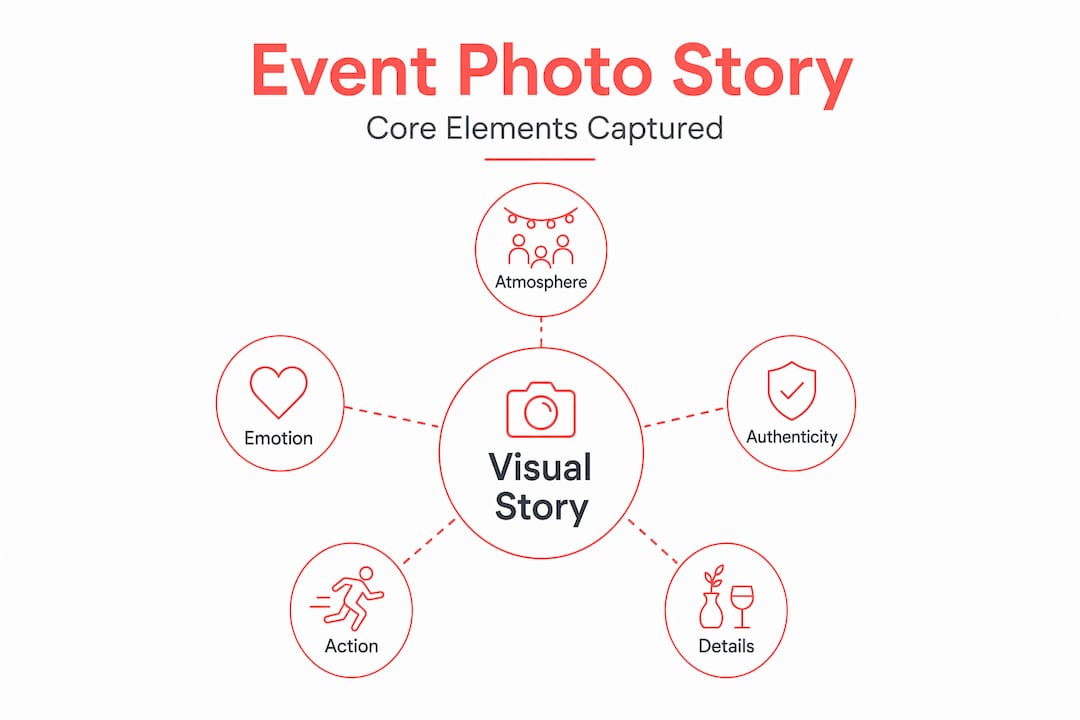
The role of event photography for businesses extends well beyond a single event. Images from a well-documented corporate gathering feed your social media calendar, support press releases, appear in recruitment materials, and live in annual reports. The corporate photographer roles that serve these functions require a genuine understanding of your brand, not just a fast shutter finger.
Here’s what corporate event photography typically covers:
Keynote and stage coverage: wide shots establishing scale, tight shots capturing expression
Networking and candid interactions: the genuine human moments that make an event feel alive
Branded signage and environmental details: logos, centrepieces, and venue elements that reinforce identity
Group portraits and team photos: formal frames that serve internal and external communications
Executive portraits: quick, professional images captured on-site for immediate use
Each of these contributes to a complete visual record that serves your organisation long after the event ends.
Key styles and shot types in corporate event photography
Understanding the role of event photography leads naturally to the styles and shot types that create compelling visuals. There’s a well-established principle worth knowing here: a target mix of roughly 70% candid and 30% posed photography strikes the ideal balance between authentic storytelling and necessary formality. Lean too far into posed shots and your gallery feels stiff. Go entirely candid and you risk missing the formal frames your communications team needs.
Candid photography tells your audience what it felt like to be there. A laugh between colleagues, a speaker’s eyes lighting up as the crowd responds, an attendee leaning in to catch every word. These are the images that make people wish they had attended and confirm to those who did that the day mattered.
Corporate event photographers deliver wide stage images, emotion-focused close-ups, branded detail shots, and group portraits. That variety is what gives your marketing team genuine options, not just a single usable image per hour.
When capturing photos at events, here are the core shot categories you should expect from any quality event photographer:
Wide establishing shots: shows the scale and energy of the room
Speaker and presenter coverage: gestures, expressions, and interaction with the audience
Audience reaction shots: laughter, engagement, note-taking, connection
Branded environmental details: signage, stage design, table arrangements, swag
Networking and break moments: where a lot of the real relationship-building happens
Formal group portraits: team photos, sponsor recognition, award presentations
Pro Tip: Share a shot priority list with your photographer before the event. Even a simple one-page document noting key speakers, award moments, and branded installations ensures nothing essential gets missed.
The candid photography balance that works beautifully in other event contexts translates directly to corporate settings, and the principle is the same: real moments carry more emotional weight than any perfectly arranged group photo.
Planning and executing successful corporate event photography
Knowing what styles and shots to capture is critical, but planning and execution are what make event photography actually successful. This is where the role of a photographer at events becomes very practical, and where the difference between an average experience and a great one gets decided.

Professional photographers assess lighting, pre-visualise venues, create shot lists, and often work in teams to cover large events. For Calgary events held in venues like the Telus Convention Centre or hotel ballrooms, lighting conditions vary widely. An experienced event photographer arrives early, walks the space, and plans camera positions before the first guest arrives.
Here’s a straightforward planning workflow for corporate event photography:
Pre-event consultation: Review the programme, confirm key moments, align on brand priorities and expectations.
Venue walkthrough: Assess lighting, identify background options, determine photographer positioning.
Shot list creation: Document must-have moments, VIP subjects, and branded elements.
Coverage day execution: Blend into the event flow while staying alert for unscripted moments.
Same-day selects (optional): Deliver a small set of highlight images immediately for social posting.
Post-event editing: Consistent colour grading, culling, and delivery within the agreed timeline.
Contracts matter here, and they’re worth reading carefully. Contracts should specify coverage hours, edited image counts, delivery timelines, usage rights, and cancellation and payment terms. These details protect you and your photographer equally. Don’t skip this step, even when working with someone you trust.
Pro Tip: For large events with multiple simultaneous sessions, ask your photographer whether they bring backup equipment or a second shooter. Events don’t pause for gear failures.
The event photography planning steps that experienced photographers follow are designed around one goal: ensuring that every moment your event planner worked months to create is documented with the care it deserves.
Planning element | Why it matters |
Pre-event shot list | Ensures priority moments are never missed |
Venue lighting assessment | Determines gear needs and camera settings |
Contract with usage rights | Protects your marketing team’s ability to use images |
Backup equipment plan | Prevents gaps in coverage from equipment issues |
Delivery timeline agreement | Keeps your social and PR calendar on schedule |
Technology and workflows that enhance event photography
In addition to planning, technology plays a crucial role in delivering polished photos quickly and consistently. This is especially relevant in 2026, when corporate clients expect fast turnaround and images ready for digital use within hours, not weeks.
Technology like tethered shooting, cloud galleries, and AI tagging speeds delivery and ensures consistent quality across a full event gallery. Here’s what that looks like in practice:
Multi-camera setups: One camera covers the main stage while a second captures candid networking moments simultaneously. Nothing falls through the cracks.
Tethered shooting: Images transfer to a laptop in real time, allowing the photographer or a client representative to review selects during the event itself.
Cloud gallery delivery: Same-day highlight galleries shared via a private link so your communications team can post before the event crowd drives home.
AI-assisted editing and tagging: Accelerates culling and colour consistency across hundreds of images, reducing delivery time without sacrificing quality.
Streamlining event coverage through these tools is not about replacing skill with software. It’s about making sure the skill you’re paying for translates into usable images as quickly as possible.
Workflow approach | Delivery speed | Consistency | Best for |
Traditional single-camera | Slower (days to weeks) | Variable | Small, simple events |
Multi-camera with cloud delivery | Fast (same day to 48 hrs) | High | Large corporate events |
AI-assisted editing pipeline | Very fast (hours for highlights) | Very high | Events with PR timelines |
How corporate event photography supports branding and marketing
Beyond capturing moments, event photography plays a vital role in building your brand’s story and reach. This is the part that often surprises first-time corporate clients: the photos you take at one event can serve your marketing team for months.
Corporate event photography is a strategic marketing asset that produces PR, social, and internal communications-ready narratives. Think about the channels where those images land:
Social media: Real, energetic images outperform stock photography every time. LinkedIn posts featuring authentic event moments regularly generate stronger engagement than polished promotional graphics.
Press releases and media kits: Journalists and editors want photos that feel like news, not advertisement. Candid, high-quality event images fit that brief perfectly.
Recruitment and HR communications: Prospective hires want to see your culture. Event photos showing a room full of engaged, connected people say more than any job description could.
Internal newsletters and company updates: Celebrating milestones and events internally builds morale and reinforces organisational identity.
Website and case studies: Event imagery adds credibility and personality to your online presence.
The business event photography impact that smart businesses experience comes from treating the photo gallery as a content library, not just a memory album. When your photographer understands your brand, every image they deliver is already aligned with how you want to show up in the world.
Why authentic storytelling beats posed perfection in corporate event photography
Here’s a perspective I’ve developed over years of shooting corporate events in Calgary: there is a persistent temptation among event planners to over-schedule posed photography. The group photo after lunch. The panel seated at the table before the discussion begins. The executive shaking hands for the camera. These have their place, absolutely. But they often crowd out something more valuable.
The images that get shared, that earn comments, that end up framed in lobbies or featured in award submissions, are almost never the posed ones. They’re the speaker caught in a moment of genuine conviction. The audience member whose expression says that changed how I think about this. The spontaneous laughter between two attendees who met an hour ago and are already exchanging contact information.
Authentic, candid event photography delivers richer narratives and performs better on social platforms than staged poses alone. That’s not a photography opinion, it’s a marketing reality. Audiences have become very good at spotting the difference between a moment and a photo-op.
The value of candid photography lies in its honesty. And in corporate settings, honesty builds trust. When a potential client sees your event photos and senses that the energy was real, that the people were genuinely engaged, it tells them something important about your organisation.
My approach to mastering event photography coverage is to stay light on my feet, blend into the room, and treat each moment as part of a sequence rather than a standalone image. Three photos of a conversation, from greeting to laughter to the handshake goodbye, tell a story that no single posed portrait can match.
Pro Tip: When you’re reviewing photographer portfolios, look for sequences, not just hero shots. A photographer who consistently captures story arcs across a gallery is one who understands what corporate event photography actually does.
Professional event photography services in Calgary with a focus on branding
If you’ve been organising corporate events in Calgary and wondering whether your current photography is doing its job, this is a good moment to take stock. You deserve images that are genuinely ready to use, not just technically acceptable.
[
At Jeff B Photography, I work with Calgary businesses and event organisers to capture corporate events with care, speed, and a clear eye for what your brand needs. Whether it’s a leadership summit, a client appreciation evening, or a product launch, the goal is always the same: real moments, branded details, and images your communications team can actually use. Services include next-day highlight galleries, full event coverage, and on-site executive portraits. Learn more about corporate photographer services, explore the business event photography guide for planning ideas, or browse Calgary’s best headshots if your team is due for updated profiles alongside your event coverage.
Frequently asked questions
What is the difference between event photography and corporate event photography?
Corporate event photography is a strategic marketing asset focused on branding, PR, and business storytelling, while general event photography covers a wider range of occasions without that specific commercial intent.
How much candid photography is recommended at a corporate event?
A target mix of roughly 70% candid and 30% posed is ideal, giving you authentic moments alongside the formal frames your communications team needs.
Why is it important to have a detailed contract with your event photographer?
Contracts should specify coverage hours, edited image counts, delivery timelines, and usage rights, so both parties know exactly what is expected and there are no surprises after the event.
Can corporate event photos be used for multiple marketing channels?
Yes. Professional event photography produces reusable marketing assets ready for social media, press releases, recruitment materials, and internal communications, often from a single event gallery.
How do professional photographers handle lighting challenges at venues?
They pre-visualise venues, note lighting placements, and adapt camera settings throughout the event to maintain consistent, high-quality results regardless of changing conditions.
Recommended
Comments