What makes a headshot look dated: a 2026 guide
TL;DR:
A headshot that looks outdated undermines credibility by reflecting past styles rather than current professionalism. Regular updates every 18 to 24 months ensure the image accurately represents your appearance and role, maintaining trust and brand consistency. Authentic, natural photos with timeless styling help keep your headshot relevant and effective for personal branding.
A headshot looks dated when its styling, editing, or professional presentation no longer aligns with current norms — and that gap quietly undermines your credibility before you say a word. Your headshot is often the first image a client, recruiter, or colleague sees on LinkedIn, a company website, or a speaker bio. When that image reflects who you were five years ago rather than who you are today, it creates a disconnect that erodes trust. Understanding what makes a headshot look dated is the first step toward protecting your professional reputation and keeping your personal brand sharp.
What makes a headshot look dated: visual age markers to watch for
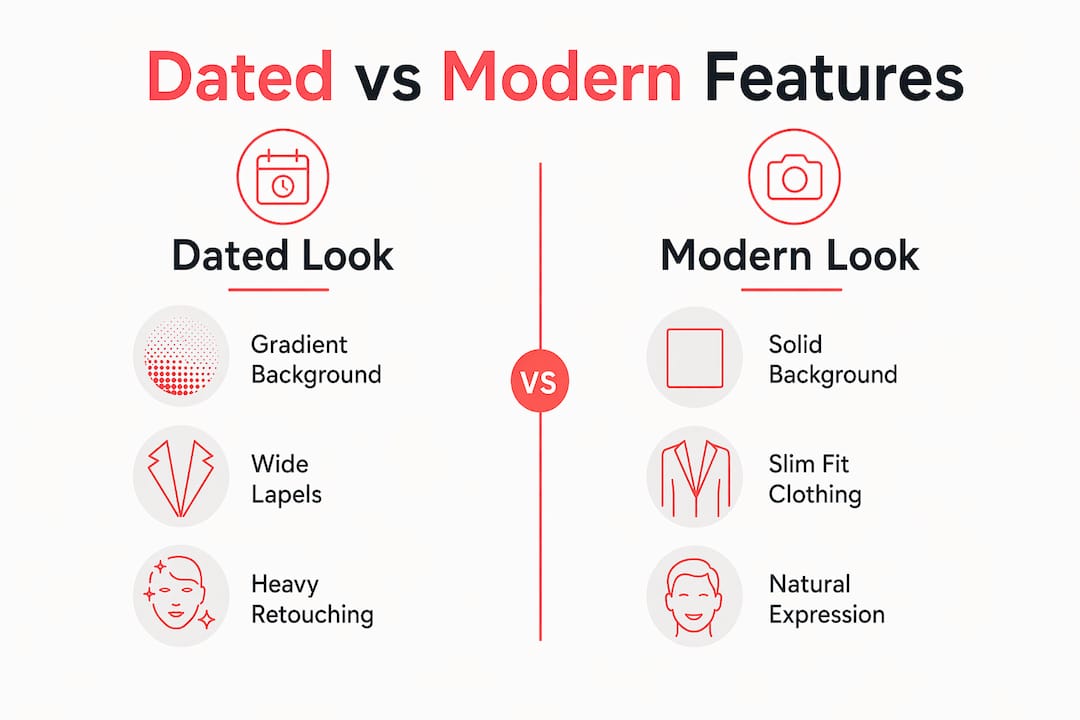
The most obvious signs of an outdated headshot live in the visible details: clothing, hairstyle, and background. These elements carry strong cultural timestamps, and viewers read them instantly, often without realising it.
Clothing is the fastest giveaway. Wide lapels, boxy blazers, or overly formal power suits from a decade ago signal a photo that has not been refreshed. The same applies to overly casual choices that no longer match your current role. Timeless professional attire — a well-fitted jacket in a neutral colour, a clean collared shirt — ages far more slowly than trend-driven pieces.
Hairstyles work the same way. A style that was fashionable in 2014 reads as a visual timestamp in 2026. Significant changes in hair length, colour, or cut since your last session are also a clear sign your photo no longer represents you accurately.
Outdated backdrops like gradient backgrounds or busy patterns date headshots immediately. Clean, subtle backgrounds support a timeless quality. Soft natural lighting with dark neutral backgrounds like navy or charcoal creates modern, lasting headshots far more effectively than the bright white or mottled grey setups that dominated earlier decades.
Element | Dated look | Modern look |
Background | Gradient, mottled grey, or busy patterns | Clean, neutral, or dark solid tones |
Clothing | Trend-driven, boxy, or era-specific styles | Timeless, well-fitted, neutral colours |
Hairstyle | Reflects a past era or no longer matches current appearance | Current, natural, consistent with real-life look |
Lighting | Harsh, flat, or producing unnatural shadows | Soft, directional, and flattering |
Editing | Heavy smoothing, plastic-looking skin | Light retouching that preserves natural texture |
Old company branding visible in the image is another overlooked problem. A logo on a backdrop, branded signage, or even a company-specific uniform from a previous employer can anchor a photo to a specific moment in time. If your career has moved on, your headshot should reflect that too.
How outdated editing and image quality date a photo
Technical choices leave a visible record. The editing style used in a headshot tells a viewer almost as much as the subject’s appearance, and older techniques are easy to spot.
Over-retouching that smooths away all skin texture creates a visual timestamp that makes headshots look artificial and quickly dated. Skin that looks airbrushed to a plastic finish was a popular editing trend in the mid-2000s and early 2010s. Heavily retouched photos with plastic-looking skin date faster than lightly retouched, natural-looking images. The current standard, as of 2026, is light retouching that balances colour and removes distractions while preserving character.
Common editing and quality issues that date a headshot include:
Heavy skin smoothing that removes all pores and natural texture
Harsh or flat lighting that creates unflattering shadows or washes out facial features
Low resolution that shows pixelation or colour shifts on modern high-resolution screens
Digital or scenic composite backgrounds that look obviously artificial
Colour grading with strong warm or cool casts that reflect a specific editing era
Expression is a technical choice too. A headshot’s “performance trap” — forced authoritative or overly posed expressions — instantly dates the image more than technical quality does. A stiff, formal pose with a rigid smile reads as performative rather than genuine. Modern professional headshots in 2026 emphasise authenticity, natural expression, and minimal retouching to maintain a timeless quality. The goal is presence, not performance.
Pro Tip: Look closely at the skin in your current headshot. If it looks smoother than your skin does in a mirror, the retouching has gone too far. Natural texture is a sign of a modern, credible image.
Why a mismatched image undermines your personal brand
A headshot that no longer reflects your current professional reality does more than look old. It creates a trust gap. Mismatch between headshot appearance and current professional role or personal brand reduces trust and undermines first impressions. When someone meets you in person or on a video call and you look noticeably different from your photo, the disconnect registers immediately.
The most common mismatch triggers include:
Significant appearance changes such as new glasses, facial hair, a major haircut, or weight change
Career stage changes where your current role carries different expectations than when the photo was taken
Industry shifts where you have moved from one sector to another with different visual norms
Outdated accessories like frames that were fashionable years ago but now read as dated
Headshots designed to be “safe” and blend into past industry norms age quickly because they lack alignment with current personal brand intent. A generic, neutral pose with no personality might have felt appropriate once, but it fails to communicate who you are now. Safe choices age faster than confident, authentic ones. Modern headshots prioritise authentic presence over posed performance, reflecting confidence and ease rather than authority or stiffness.
The qualities of a great headshot in 2026 are built around genuine expression and alignment with your current professional identity, not a polished version of who you used to be.
How often should you update your headshots?
The typical refresh cycle for professional headshots is 18–24 months, or after significant appearance changes like a hairstyle or weight change. That timeline is a useful baseline, but specific life and career events should trigger an earlier update.
Hairstyle change — a new cut, colour, or significant length change means your photo no longer matches your daily appearance.
New glasses or no glasses — eyewear is one of the most noticeable facial features in a headshot.
Career change or promotion — a new role often comes with a different professional context and audience.
Significant weight change — your photo should look like you when you walk into a room.
New employer or brand — if your company has rebranded or you have moved on, your headshot context may need to follow.
Facial hair change — growing or removing a beard changes your appearance substantially.
Waiting until the mismatch is obvious is the wrong approach. By the time clients or colleagues notice the difference, the trust gap has already formed. Proactive updates signal that you take your professional image seriously. For a fuller picture of when and why to refresh, the professional guide to updating headshots at Itsjeffb covers the timing and reasoning in practical detail.
Pro Tip: Set a calendar reminder every 18 months to review your headshot against your current appearance. A quick side-by-side comparison with a recent photo is often all it takes to see whether an update is overdue.
Self-assessment checklist: is your headshot still working for you?
Use this checklist to evaluate whether your current headshot still represents you accurately. Be honest. The goal is not to find reasons to keep the photo. The goal is to find out whether it is still doing its job.
Clothing: Does your outfit reflect how you dress professionally today, or does it belong to a past era?
Hairstyle: Does your hair in the photo match your current style and length?
Background: Is the backdrop clean and neutral, or does it look busy, gradient, or obviously artificial?
Lighting: Does the lighting look natural and flattering, or harsh and flat?
Editing: Does your skin look natural, or has retouching removed texture and character?
Expression: Do you look at ease and genuine, or stiff and posed?
Role alignment: Does the image reflect your current career stage and industry?
Recognition: Would someone who met you today recognise you immediately from the photo?
If you answered “no” to two or more of these questions, your headshot is likely working against you. The signs you need new headshots are often subtle at first, but they compound over time. A photo that felt current two years ago can feel noticeably stale today. Run through this checklist every 12–18 months to stay ahead of the gap.
Key takeaways
A headshot looks dated primarily because of outdated styling, heavy retouching, and a mismatch between the image and the professional’s current appearance or role.
Point | Details |
Visual elements date fastest | Clothing, hairstyle, and background are the clearest signs of an outdated headshot. |
Over-retouching is a timestamp | Heavy skin smoothing and plastic-looking edits date a photo faster than any styling choice. |
Mismatch erodes trust | When your photo no longer looks like you, it creates a credibility gap before you speak. |
Update every 18–24 months | Refresh sooner after major appearance changes, career shifts, or new employer branding. |
Authenticity ages better | Natural expression and light retouching produce headshots that stay relevant longer. |
What I’ve learned from years of headshot sessions
The thing that surprises most professionals when they finally update their headshot is how much lighter they feel about it afterward. There is a quiet confidence that comes from knowing your image actually represents you.
What I see most often, honestly, is hesitation. People hold onto old photos because updating feels like a big production. But the photos that age worst are the ones taken when someone was trying too hard to look “professional.” The stiff jaw, the forced smile, the blazer that felt like armour. Those images carry the weight of performance, and viewers feel it.
The photos that hold up over time are the ones where the person is simply present. Not performing authority. Not trying to look like a stock photo. Just showing up as themselves, well-lit and well-framed. Technical quality alone does not prevent a headshot from dating. Stylistic and authentic expression choices have more impact on longevity than any camera or lighting setup.
My honest advice: stop waiting for the “right time” to update. The right time was probably 18 months ago. The second best time is now. Your headshot is often the first handshake you offer the world. Make sure it actually sounds like you.
— Jeff
Fresh headshots for Calgary professionals
Your headshot is a working asset, not a one-time task. When it stops reflecting who you are, it starts working against you.
[
At Itsjeffb, headshot sessions are built to be straightforward and genuinely stress-free, especially for professionals who are not used to being in front of a camera. The focus is on clean, natural images that align with your current role, your industry, and the impression you want to make on LinkedIn, your website, or your next pitch deck. Whether you need a solo session or consistent headshots for your whole team, Itsjeffb brings the expertise and the ease. Book your session and walk away with a photo you are actually proud to use.
FAQ
What makes a headshot look dated most quickly?
Clothing styles, hairstyles, and editing techniques are the fastest-ageing elements in a professional headshot. Over-retouching that removes natural skin texture is a particularly strong visual timestamp.
How often should professionals update their headshots?
The standard refresh cycle is every 18–24 months. Update sooner after significant appearance changes such as a new hairstyle, glasses, facial hair, or a career transition.
Does image quality alone determine whether a headshot looks old?
No. Technical quality has less impact on longevity than stylistic and expression choices. A high-resolution photo with a stiff pose and heavy retouching will still look dated.
What background works best for a modern headshot?
Clean, neutral, or dark solid backgrounds like navy or charcoal read as current and timeless. Gradient, mottled, or busy backgrounds are clear signs of outdated photography.
How do I know if my headshot no longer matches my professional brand?
Ask whether someone meeting you today would recognise you immediately from the photo. If your appearance, role, or industry has changed significantly since the session, the image likely no longer serves your brand.
Recommended
Comments