Why consistency in headshots builds real trust
TL;DR:
Consistent headshots signal organization, credibility, and professionalism, influencing trust before any words are read.
Establishing and maintaining a visual standard prevents progressive style drift, ensuring cohesive team imagery across platforms.
Consistency in headshots is defined as the deliberate alignment of lighting, background, framing, and retouching across all professional portraits to create a unified visual identity. Whether you are a solo professional building a personal brand or a team of fifty showing up on a corporate website, this visual uniformity is not a cosmetic preference. It is a credibility signal. Visual design and image quality influence trust judgments before a single word is read, making your headshots one of the fastest trust-builders or trust-breakers in your professional toolkit.
Why consistency in headshots matters for first impressions
The human brain forms a visual credibility judgement in approximately 50 milliseconds. That is faster than a blink. In that window, a viewer is not reading your bio or scanning your credentials. They are absorbing the overall visual impression, and mismatched headshots create immediate friction.
“Inconsistency in headshots signals absence of brand governance and operational care. It is an operational signal, not just a marketing detail.”
When a team page shows five people photographed under warm studio light and three others photographed in a dim office corridor, the subconscious reaction is not neutral. Viewers register the mismatch as a sign that the organisation lacks attention to detail. That reaction happens before any conscious thought kicks in.
This is why the importance of headshot consistency goes well beyond aesthetics. Consistent portraits tell a viewer that your team is coordinated, that your brand is governed, and that you take your professional presentation seriously. Mismatched crops, clashing backgrounds, and wildly different colour tones send the opposite message, even when every individual photo is technically fine on its own.
The patchwork effect is real. A team page that looks like a collage of photos pulled from different decades and different continents does not inspire confidence. It raises questions. And in a world where a prospective client, recruiter, or partner is making a snap judgement about whether to engage with you, those questions are costly.
What causes headshot inconsistency in teams?
Corporate headshot inconsistency is almost always the result of gradual drift rather than a single bad decision. Understanding the root causes is the first step to fixing them.
Incremental additions over time. A company photographs ten people in 2022, adds five new hires in 2024 with a different photographer, and fills gaps with LinkedIn profile photos pulled from personal accounts. Each decision seems reasonable in isolation. The cumulative result is visual chaos.
Multiple photographers and locations. Different photographers have different default settings for focal length, background distance, and colour grading. Without a shared brief, two photographers will produce two distinct looks even when shooting the same subject.
No wardrobe or styling guidance. One person wears a bold patterned shirt. Another is in a dark blazer. A third is in a casual hoodie. Wardrobe variation is one of the most visible sources of inconsistency and one of the easiest to prevent with a simple written guideline.
Inconsistent retouching standards. Retouching mismatches are subtle but powerful. One portrait has heavy skin smoothing while another is barely touched. The result is a team page that feels uneven, even if viewers cannot articulate why.
No internal ownership. When nobody is responsible for the headshot system, nobody notices when it starts to drift. Photos accumulate without a reference point, and the standard erodes quietly.
Pro Tip: Assign one person internally, whether in HR, marketing, or operations, to own the headshot standard. Give them a reference set of approved photos and a one-page brief covering lighting style, background colour, crop ratio, and wardrobe guidance. That document is worth more than any single photography session.
The fix is not complicated, but it does require intention. Treating your headshot programme as a governed visual system rather than a one-off task is what separates organisations that look polished from those that look assembled.
What are the real benefits of uniform headshots?
Consistent headshots do more than make a team page look tidy. They actively build the kind of trust that converts browsers into clients and candidates into hires.
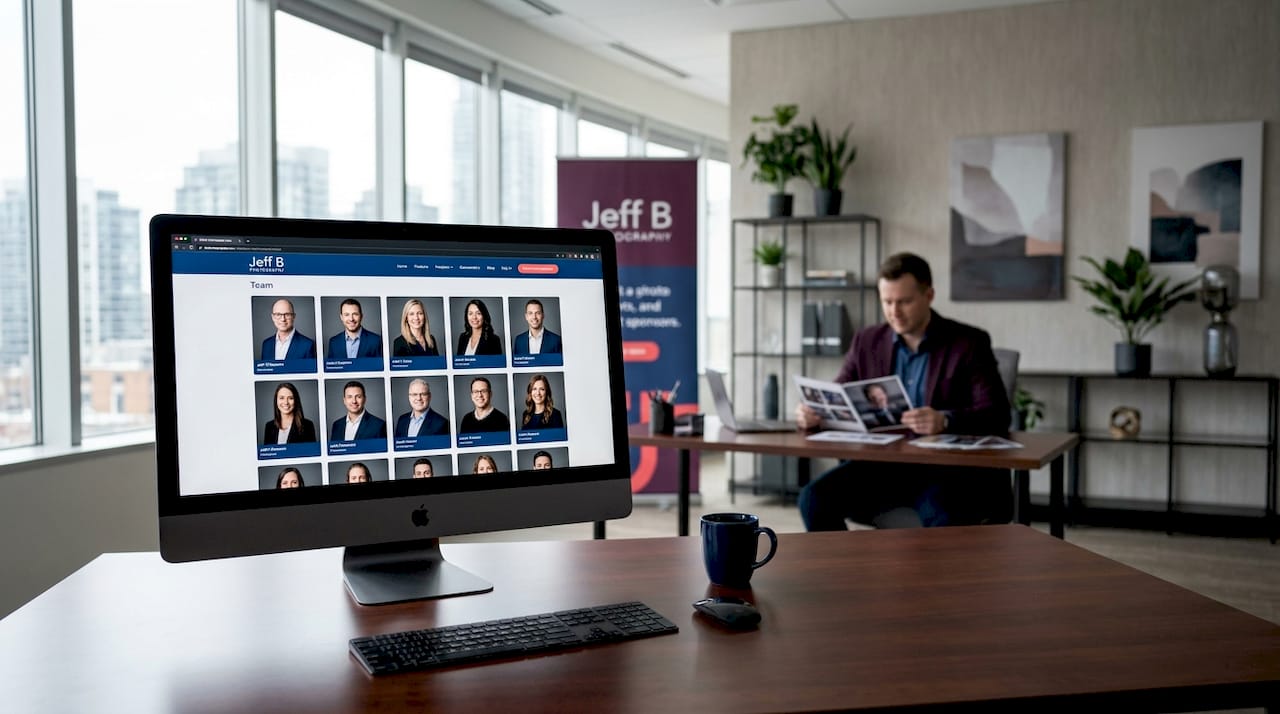
Stable framing, lighting, and expression create repeated visual cues that make a face easier to recognise across platforms. When your LinkedIn photo, your website bio, your conference speaker profile, and your email signature all show the same version of you, people start to feel like they know you. That familiarity is not accidental. It is the psychology of brand recognition applied to a person.
For teams, the benefits of uniform headshots extend to organisational cohesion. A consistent set of portraits communicates that the people in them are part of something deliberate and well-run. It reinforces the idea that the organisation invests in its people and takes its public presentation seriously. That perception matters enormously in professional services, where trust is the product.
Consistent imagery also supports your presence across every channel without extra effort. When your headshots are already aligned in crop ratio and colour tone, they drop cleanly into website templates, press releases, LinkedIn profiles, pitch decks, and marketing materials. You are not scrambling to find a photo that fits. The system does the work for you.
There is also a personal brand dimension worth noting. How headshot style impacts branding at the individual level is often underestimated. A professional who shows up with the same clean, confident portrait across every touchpoint projects stability and reliability. A professional whose photos vary wildly in quality and style projects inconsistency, and that perception bleeds into how their work is perceived.
How to create and sustain headshot consistency
Building a consistent headshot system does not require a massive budget. It requires a clear standard and the discipline to maintain it.
Set a documented visual standard
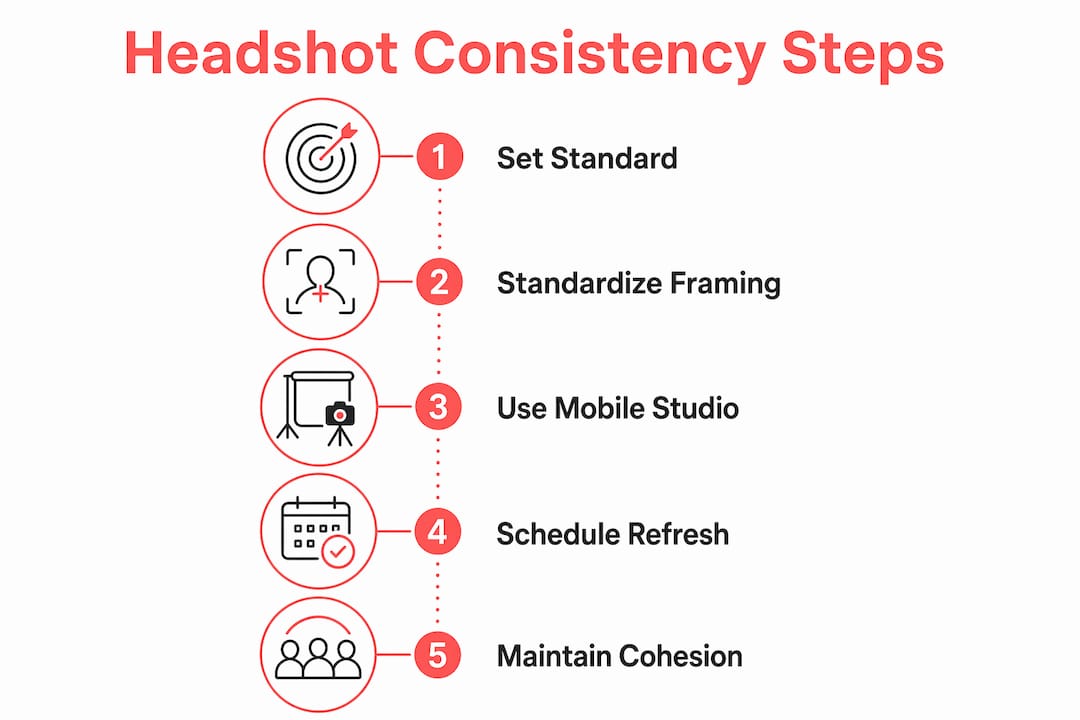
Treat your headshots as a governed visual system with written rules for lighting style, lens choice, crop ratio, background colour, and retouching approach. This document does not need to be long. A single page with reference images is enough to brief any photographer and keep your team aligned over time.
Standardise framing for every platform
Framing and cropping must account for how images will actually be displayed. A headshot that looks perfect at full size may crop awkwardly inside a circular LinkedIn thumbnail or a narrow website card. Shoot with platform display requirements in mind and deliver multiple crop versions as part of every session.
Use on-site or mobile studio sessions
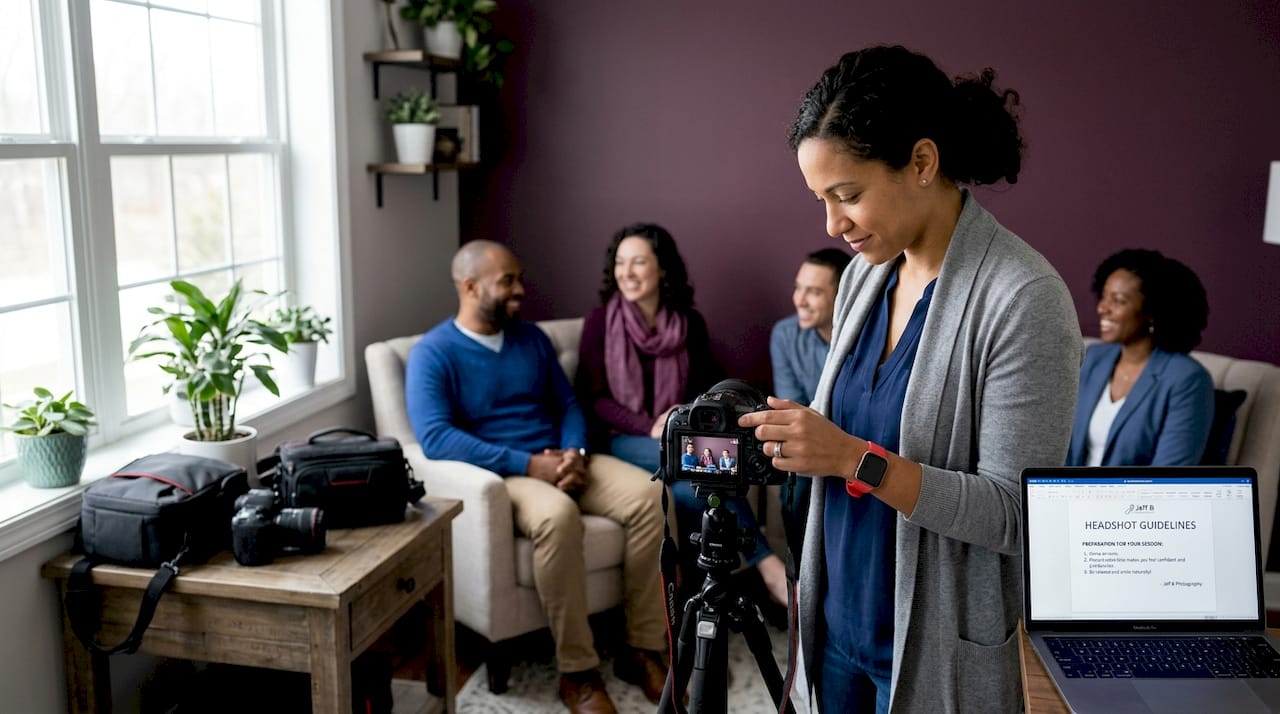
Mobile studio headshot sessions bring controlled lighting and consistent backgrounds directly to the workplace. This removes the single biggest variable in team photography: location. When everyone is photographed in the same controlled environment on the same day, the results are naturally cohesive. It also reduces the disruption of sending staff offsite for individual sessions.
Approach | Consistency outcome |
Individual sessions at different studios | High risk of style drift across photographers and settings |
Group session at one external studio | Good consistency if all shot same day with same brief |
On-site mobile studio session | Best consistency, minimal disruption, controlled environment |
DIY photos from personal devices | Very high inconsistency, low perceived professionalism |
Plan for regular refresh cycles
Operational ownership means scheduling headshot refreshes proactively rather than reactively. A good rule of thumb is a full team refresh every two to three years, with new hire sessions built into the onboarding process. This prevents the gradual accumulation of mismatched photos that creates the patchwork effect over time.
Pro Tip: When onboarding new team members, include headshot booking as a standard step alongside IT setup and benefits enrolment. A new hire photographed within their first two weeks will match the existing team standard far better than one photographed six months later with a phone in a hallway.
For individuals, the same logic applies. Updating your LinkedIn headshot after a significant career change, a rebrand, or simply after three or more years keeps your visual identity current and credible. Stale photos erode trust in the same quiet way that inconsistent team photos do.
Key takeaways
Consistent headshots build trust faster than any other visual element because they signal organisation, credibility, and care before a single word is read.
Point | Details |
First impressions are instant | Viewers form credibility judgements in 50 milliseconds, making visual consistency a primary trust signal. |
Inconsistency signals poor governance | Mismatched lighting, crops, and retouching imply a lack of organisational care, not just aesthetic variation. |
Uniformity supports every platform | Consistent headshots drop cleanly into websites, LinkedIn, press materials, and pitch decks without extra effort. |
Ownership prevents drift | Assigning internal responsibility and maintaining a reference set stops gradual inconsistency before it compounds. |
Mobile studios solve the hardest problem | On-site photography sessions remove location variables and produce naturally cohesive results across entire teams. |
Why I think headshot consistency is an underrated business asset
I have photographed a lot of teams in Calgary, and the pattern I see most often is not a team that made one bad decision. It is a team that made twenty reasonable decisions over five years and ended up with a team page that looks like a yearbook from three different schools.
The moment a client sees that patchwork, something shifts. It is not a conscious thought. It is a feeling. And that feeling is the opposite of confidence. What strikes me most is that the fix is almost never expensive. It is almost always a matter of planning. One session, one brief, one person who owns the standard going forward.
I also think the personal branding dimension is undervalued. When I work with individuals on their corporate headshot, the ones who get the most mileage from the photos are the ones who use the same image consistently across every platform for two or three years. They become recognisable. People feel like they know them before they have ever met. That is not luck. That is the compound effect of consistent visual identity.
The organisations that treat headshots as a system rather than a task are the ones whose teams look like they belong together. And looking like you belong together is, quietly, one of the most powerful things a professional brand can communicate.
— Jeff
Get consistent, professional headshots for your Calgary team
If your team page is overdue for a refresh, or if you are building a personal brand and want photos you will actually be proud to use, Itsjeffb makes the process straightforward and stress-free.
[
Jeff B Photography offers on-location team headshots in Calgary with a consistent, controlled setup that works across your entire group in a single session. No offsite travel, no style drift, no patchwork results. For individuals, the monthly headshot special is a great way to get a clean, current portrait at an accessible price point. Check out session pricing and options to find the right fit for your team or personal brand goals.
FAQ
Why does headshot consistency matter for a team page?
Consistent headshots signal that your organisation is coordinated and professional. Mismatched portraits create a patchwork effect that undermines viewer trust before any content is read.
How often should professional headshots be updated?
A full team refresh every two to three years is a practical standard, with new hire sessions built into onboarding. Individuals should update their headshot after a significant career change or after three or more years with the same image.
What are the most common causes of headshot inconsistency?
The most common causes are multiple photographers without a shared brief, incremental photo additions over time, no wardrobe guidance, and inconsistent retouching standards across sessions.
Can on-site photography sessions really improve consistency?
Yes. On-site mobile studio sessions bring controlled lighting and consistent backgrounds to the workplace, removing location as a variable and producing naturally cohesive results across an entire team in a single session.
Does headshot consistency matter for personal branding on LinkedIn?
Absolutely. Using the same clean, well-lit portrait consistently across LinkedIn, your website, and other professional platforms builds recognition and trust over time, which is the foundation of a strong personal brand presence.
Recommended

Comments