Why display portraits at work: culture and brand
TL;DR:
Displaying professional portraits at work enhances company culture, employee confidence, and brand trust. Well-placed, high-quality portraits communicate authenticity, foster belonging, and strengthen client and employee perceptions. Strategic display and style choice significantly impact workplace environment and organizational reputation.
Displaying professional portraits at work is a direct investment in company culture, employee confidence, and brand credibility. Known formally as corporate portrait display, this practice signals to clients, recruits, and staff that your organisation values its people. Research from the University of Exeter shows that enriched environments boost productivity by 15–32%. That number alone should make any HR leader or executive pay attention. The question of why display portraits at work has a clear answer: because the walls of your office are already communicating something. The only choice is whether that message is intentional.
Why display portraits at work: the core business case
Corporate portrait display is the deliberate placement of professional photographs of people, whether individual headshots, team portraits, or contextual working images, within a physical workspace. The goal is to shape how employees, clients, and visitors experience your organisation.
Photographer Martin Bamford describes professional portraits as “trust signals” that influence how clients and partners perceive your business before a single conversation happens. That perception forms fast. Princeton researchers Willis and Todorov found that viewers form trust judgements from faces in approximately 100 milliseconds. Your lobby portrait is doing real work before your receptionist says hello.
The benefits of workplace portraits extend well beyond aesthetics. They communicate organisational values, reinforce brand identity, and create an environment where people feel seen and recognised. For HR professionals, that last point matters enormously. When employees see their own faces on the wall, they feel like contributors, not just headcount.
How do portraits improve employee engagement and atmosphere?
The psychological case for art in the workplace is well established, and portraits are a particularly potent form of it. University of Exeter research found that employees in enriched, art-decorated environments show productivity gains of 15–32% compared to those in lean, undecorated spaces. That is not a marginal improvement. It is the kind of number that belongs in a board presentation.
Professor Semir Zeki’s neuroaesthetics research found that art stimulates the brain in ways similar to seeing a loved one, increasing blood flow to areas associated with pleasure and reward. In a world where most employees spend eight hours staring at screens, a well-placed portrait on the wall provides genuine cognitive relief. It breaks the cycle of digital fatigue in a way that another motivational poster simply cannot.
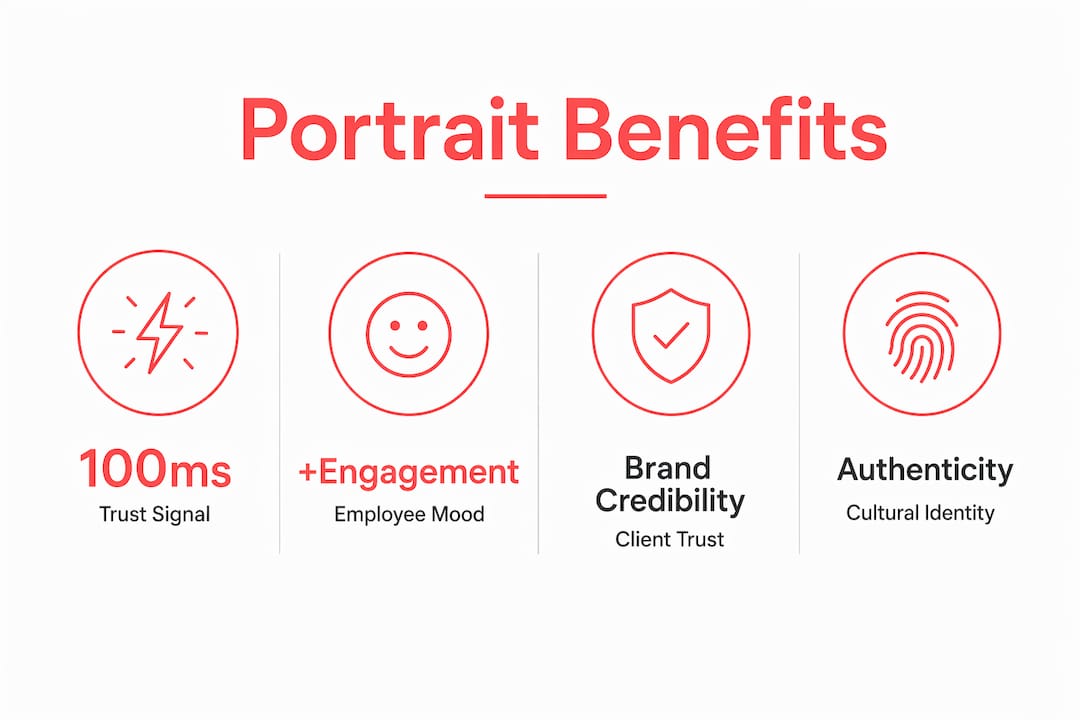
Art also functions as what researchers call “cultural infrastructure”, shaping how people interact, collaborate, and identify with their workplace. A survey of 800 employees across 32 organisations found that 78% reported stress reduction when art was present in their work environment. Portraits, in particular, add a human dimension that abstract art cannot replicate.
Here is what the research points to in practical terms:
Productivity lift: Enriched environments with art and photography improve output by 15–32%, according to University of Exeter findings.
Stress reduction: 78% of employees in art-rich offices report lower stress levels, which directly affects retention and absenteeism.
Cognitive recovery: Neuroaesthetic research confirms that viewing faces and art restores mental energy depleted by screen work.
Belonging and recognition: Seeing your own portrait displayed signals that the organisation values you as an individual, not just a role.
Pro Tip: Place team portraits in collaborative zones like meeting rooms and breakout areas, not just in reception. Employees who see themselves represented in shared spaces report stronger team identity.
How do professional portraits influence brand identity and client trust?
The impact of portraits at work on brand perception is immediate and measurable. When a client walks into your office and sees a wall of polished, consistent team portraits, they read it as a signal of competence, unity, and attention to detail. When they see a blank wall or a generic stock photo of a handshake, they read something else entirely.
Consistent, high-quality portraits across leadership and teams reflect a brand that is organised, intentional, and proud of its people. That coherence matters in client-facing environments. It also matters in recruitment. Candidates touring your office are evaluating your culture in real time, and the walls are part of that evaluation.
Here is how portraits function across key business contexts:
Client relations: A portrait wall in reception communicates that real, accountable people work here. It replaces anonymity with faces, which builds immediate rapport.
Recruitment: Candidates who see diverse, authentic team portraits during a site visit form a more positive impression of company culture than those who see generic décor.
Marketing and communications: Portraits used in marketing materials increase engagement and trust with both clients and prospective talent.
Internal culture: Displaying leadership portraits alongside team portraits signals a flat, human organisation rather than a distant hierarchy.
“The right portrait changes how people treat you before you’ve said a word. It sets the tone for every interaction that follows.” — Martin Bamford, professional photographer
The importance of display photos extends to your digital presence as well. Portraits used on LinkedIn profiles, company websites, and email signatures carry the same trust signals as physical displays. The role of professional photography in building brand identity is consistent across every channel where your people appear.
Traditional headshots vs. contextual portraits: which builds better culture?
Not all portraits serve the same purpose. The style you choose communicates as much as the decision to display portraits at all.
Portrait Style | Characteristics | Cultural Signal |
Traditional studio headshot | Uniform backdrop, controlled lighting, formal pose | Professional, consistent, but can feel rigid |
Environmental portrait | Taken in actual workspace, natural light, candid pose | Authentic, human, collaborative |
Working portrait | Subject engaged in real tasks, colleagues visible | Dynamic, transparent, team-oriented |
Leadership portrait | Executive in office context, confident but approachable | Accessible authority, not distant hierarchy |
Studio Grey’s research on authentic office portraits is direct on this point: uniform backdrops for all employees risk conveying a “rigid corporate machine” impression. Contextual portraits, taken in actual working environments, communicate a more human and collaborative culture. That distinction matters when you are trying to attract talent or retain employees who value authenticity.
Traditional headshots still have a place. They work well for LinkedIn profiles, press releases, and situations where consistency across a large team is the priority. But for office display, contextual portraits carry more warmth and story. They show people doing real work in a real place, which is exactly the kind of brand story a physical space should tell.
Pro Tip: Mix portrait styles intentionally. Use consistent studio headshots for your website’s team page, and reserve contextual working portraits for office walls. Each format serves a different audience and purpose.
Practical strategies for displaying portraits to maximise impact
Knowing why to display portraits is only half the work. Where and how you display them determines whether they reinforce your brand or create visual clutter.
Placement and scale
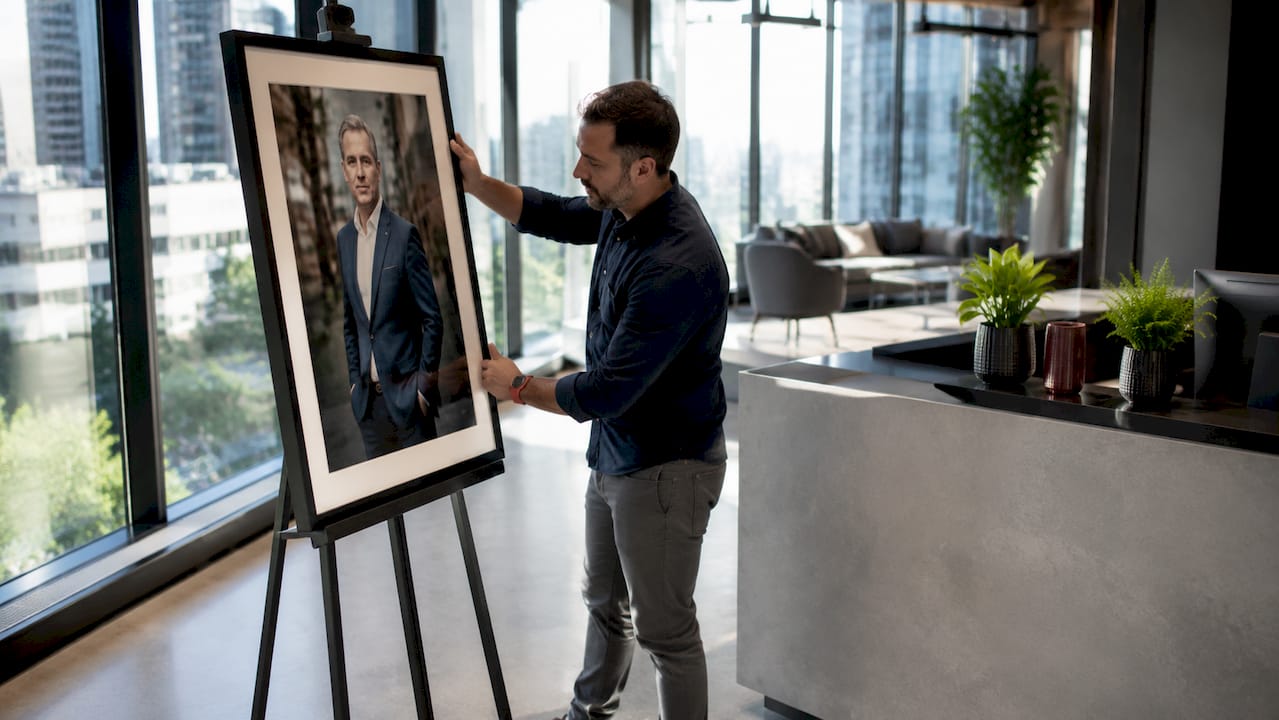
Reception is the highest-value location for portrait display. Design guidance from Bruzzen confirms that one large statement piece in reception is more effective than a gallery wall, which can overwhelm visitors at first contact. A single, well-framed portrait or team photograph measuring 36–48 inches wide creates clarity and confidence. It says: this is who we are.
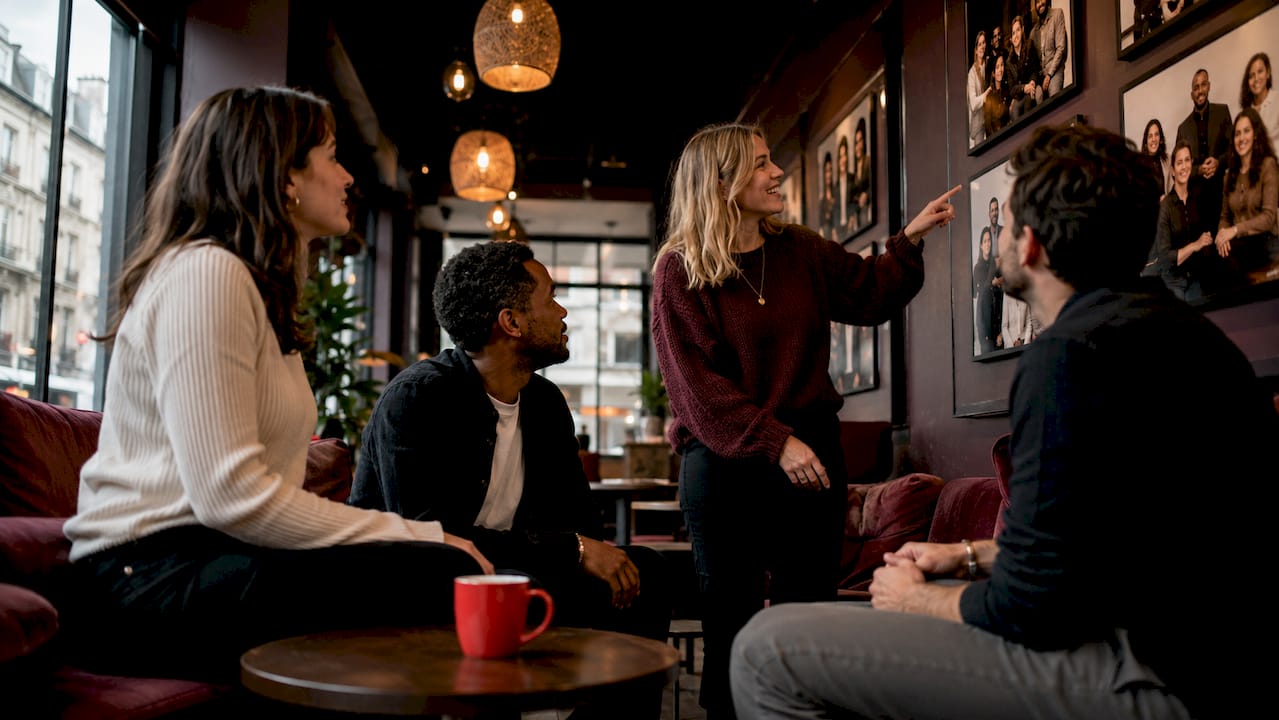
Collaborative zones like boardrooms, breakout areas, and hallways are ideal for gallery-style portrait displays. These spaces invite longer viewing and conversation, which makes them well suited to richer storytelling through multiple portraits.
Presentation and consistency
Frame consistency matters. Matching frames across a portrait series signals intentionality. Mixing ornate gold frames with industrial black ones sends a mixed message about your brand’s visual identity. Choose a frame style that aligns with your office aesthetic and apply it uniformly.
Generic stock photography fails to communicate brand identity effectively. A photo of a smiling stranger in a suit tells your clients nothing about your actual team or culture. Real portraits of real people are always the stronger choice.
Common display mistakes to avoid
Displaying outdated portraits of employees who have since left the organisation
Using low-resolution images printed at large scale, which signals poor attention to detail
Overcrowding walls with too many small portraits, which creates visual noise rather than impact
Ignoring lighting conditions near the display, which can wash out or distort portrait colours
The advantages of personal photos in a workplace setting are real, but only when the execution is thoughtful. A poorly displayed portrait is worse than no portrait at all. It suggests the organisation started something and did not follow through.
Key takeaways
Displaying professional portraits at work builds trust, reinforces brand identity, and creates a more engaged, productive workforce through both psychological and cultural mechanisms.
Point | Details |
Portraits are trust signals | Viewers form trust judgements in 100 milliseconds, making displayed portraits critical to first impressions. |
Enriched environments boost output | University of Exeter research shows productivity improves by 15–32% in art-decorated workspaces. |
Portrait style shapes cultural message | Contextual working portraits communicate authenticity and collaboration better than uniform studio backdrops. |
Placement determines impact | One large portrait in reception outperforms a gallery wall for clarity and confidence at first client contact. |
Consistency builds brand credibility | Coordinated, high-quality portraits across teams signal competence, unity, and organisational pride. |
What i’ve learned after years of photographing teams
Here is something I have noticed across dozens of corporate portrait sessions: the organisations that display their team photos with intention are almost always the ones with the strongest internal culture. It is not a coincidence.
When a company invests in professional portraits and actually puts them on the wall, something shifts. Employees stand a little taller. New hires feel like they are joining something real. Clients walk in and immediately sense that the people here are proud of what they do. That is not something you can manufacture with a motivational quote or a branded colour palette.
What I push back on is the idea that any portrait will do. I have seen offices where someone printed team photos on a home printer and taped them to a corkboard. The intention was good. The effect was the opposite of professional. The quality of the portrait and the quality of the display are both part of the message.
The other thing I would flag for HR leaders specifically: do not leave people out. If your portrait wall features only the executive team, you are sending a message to everyone else. The most effective displays I have seen include people at every level, from the front desk to the C-suite. That kind of representation builds the belonging that retention strategies are always chasing.
If you are wondering where to start, the answer is simple. Get a professional session booked, choose a consistent display format, and put the portraits somewhere people actually see them. The connection and presence that good portraits create is worth every bit of the effort.
— Jeff
Ready to put your team on the wall?
At Itsjeffb, we work with Calgary businesses to create corporate portraits that are worth displaying. Whether you need consistent headshots for a team of five or a full branding session for a company of fifty, the process is straightforward and the results are photos your people will actually be proud of.
[
From team headshots at your office to individual branding portraits, every session is built around efficiency, consistency, and making the experience easy for people who are not used to being in front of a camera. Check out photography pricing and packages to find the right fit for your team. Let’s get your people on the wall where they belong.
FAQ
What are the main benefits of displaying portraits at work?
Displaying portraits improves employee engagement, reduces stress, and signals brand credibility to clients. University of Exeter research links enriched environments to productivity gains of 15–32%.
How do workplace portraits affect client trust?
Princeton researchers found that trust judgements form in approximately 100 milliseconds from viewing a face. Professional portraits displayed in reception create an immediate positive impression before any conversation begins.
What portrait style works best for office display?
Contextual working portraits taken in actual office environments communicate authenticity and collaboration more effectively than uniform studio backdrops, according to Studio Grey’s research on authentic office portraits.
Where should portraits be displayed in an office?
Reception is the highest-impact location for a single large portrait or team photograph. Collaborative zones like boardrooms and breakout areas work well for gallery-style displays with multiple portraits.
How often should workplace portraits be updated?
Portraits should be updated whenever significant team changes occur, or at minimum every two to three years. Displaying outdated portraits of former employees undermines the trust signals that professional imagery is meant to create.
Recommended

Comments