
Why team headshots matter for Calgary businesses
- Jeff Borchert
- Apr 30
- 9 min read

TL;DR:
Team headshots create a consistent and professional visual system for branding and credibility.
Updated headshots enhance internal communication, fostering trust and a sense of belonging.
Viewing headshots as an ongoing investment improves brand perception, team morale, and client trust.
Team headshots are easy to dismiss as a nice-to-have, something you schedule once, forget about, and hope still looks presentable a few years later. But that thinking undersells a genuinely powerful business asset. The advantages team headshots bring to professional service organisations are real, measurable, and growing more important as first impressions increasingly happen online before anyone ever shakes hands. Whether you lead a 10-person boutique firm or manage HR for a 200-person Calgary corporation, this guide will show you exactly how team headshots influence branding, communication, and client trust, and what you can do to make yours work harder.
Table of Contents
Key Takeaways
Point | Details |
Improve brand credibility | Professional team headshots present your business as trustworthy and unified. |
Foster team culture | Headshots reinforce a sense of belonging and connection among staff. |
Support internal communications | Clear, updated headshots help employees identify and collaborate with colleagues. |
Attract and retain clients | High-quality photos differentiate your company and create a stronger first impression. |
Defining team headshots and their modern role
Let’s start with a clear baseline. A team headshot in a corporate context is a professional photograph taken with intentional consistency across an entire group of people. It is not a screenshot from last year’s holiday party. It is not a selfie with decent lighting. It is a deliberate, coordinated image that communicates something specific about who a person is and where they work.
What separates a team headshot from a casual or individual portrait is consistency. When every person in your organisation appears with similar lighting, backgrounds, cropping, and colour treatment, those images become a visual system. Individually, each photo says “this person is professional.” Together, they say “this company has its act together.”
Professional photos of a person provide advantages that go well beyond aesthetics, and the platforms that display them are everywhere. Here is where your team headshots are actively working for you:
LinkedIn profiles: Visitors decide within seconds whether to engage with a profile. A sharp headshot signals credibility instantly.
Company website “About us” page: This is often the most visited page after the homepage. First-time clients and candidates are making judgements here.
Email signatures: A face attached to a name builds familiarity and trust in ongoing correspondence.
Press releases and media coverage: Journalists and editors pull team photos when featuring companies or executives.
Internal directories and org charts: New employees and cross-departmental colleagues rely on these daily.
Pitch decks and proposals: Showing who your team is can be the detail that closes a deal.
If you want a deeper look at what separates good headshots from great ones, the complete headshot guide covers the full picture from framing to final delivery.
Enhancing brand identity and corporate trust
Here is something worth sitting with for a moment. Your brand is not just your logo or your colour palette. It is the total impression people carry after every touchpoint, including the faces associated with your company.
“Your team photos are part of your brand story. Cohesive imagery tells clients and partners that your organisation is coordinated, intentional, and professional before a single word is read.”
Cohesive team imagery is a genuine brand differentiator, particularly in a competitive city like Calgary where professional service firms are constantly jostling for attention in finance, energy, legal, and technology sectors. When your competitors show up online with inconsistent, dim, or outdated headshots and your team appears polished and unified, that contrast does real work for you.
Consider how trust is built online. Studies consistently show that people form opinions about a website and its credibility within the first few seconds. A team page with sharp, consistent headshots reinforces that the organisation is reliable. Mismatched photos, some professional and some clearly taken on phones, create a subtle but persistent sense of disorganisation.

Consistency versus inconsistency: what clients actually see
Feature | Consistent team headshots | Mismatched or informal photos |
First impression | Polished, coordinated, trustworthy | Disorganised, uneven, uncertain |
Brand alignment | Reinforces logo, colour, and tone | Dilutes or contradicts brand identity |
Client confidence | Higher before first contact | Lower, more hesitation |
Internal pride | Team feels seen and valued | Can feel overlooked or unimportant |
Longevity | Designed to age gracefully | Quickly looks dated |
Pro Tip: When planning a team photo session, choose a background and lighting style that reflects your brand’s personality. A law firm might prefer darker, more formal tones. A tech startup might lean into clean, bright, airy settings. The background is not neutral. It is communicating something.
Team branding photo ideas can help you think through the creative choices that make your images feel uniquely yours rather than generic stock-photo substitutes.
Boosting internal communication and culture
Most conversations about headshots focus on external audiences. Clients, partners, the public. But the internal value is just as compelling, and in a hybrid or remote work environment, arguably more urgent.
Think about what it feels like to join a new organisation. You receive an employee directory with 80 names on it. You are expected to collaborate with people across departments you have never physically met. Without headshots, those names are abstractions. With them, they become people. That shift matters more than most executives realise.
Team headshots strengthen internal communication by reducing the friction of “putting a face to a name.” When someone can look up a colleague before a first meeting or quickly identify who sent them an email, interactions become warmer and more efficient. New hires onboard faster. Cross-departmental relationships form more easily.
Here is a practical walkthrough of how to leverage headshots for internal wins:
Update your internal directory first. Before external use, build a searchable internal photo directory. This is the fastest way to drive immediate cultural value.
Use headshots in onboarding materials. Include team photos in welcome packages so new employees recognise faces on day one.
Add photos to email signatures across the company. Even a small thumbnail creates a more personal interaction in every email thread.
Feature team photos in internal newsletters. Celebrating milestones, promotions, or project completions with photos keeps the whole company connected.
Display team headshots in physical spaces. Reception areas and meeting rooms with team photos create a sense of belonging, particularly for hybrid staff who may rarely be in the office.
Remote and hybrid structures have made face-to-face familiarity genuinely rare. A well-maintained photo directory is one of the simplest and most affordable ways to close that gap. The return on investment here is not just cultural, either. Research on distributed teams consistently points to familiarity and trust as key factors in collaboration quality and employee retention.
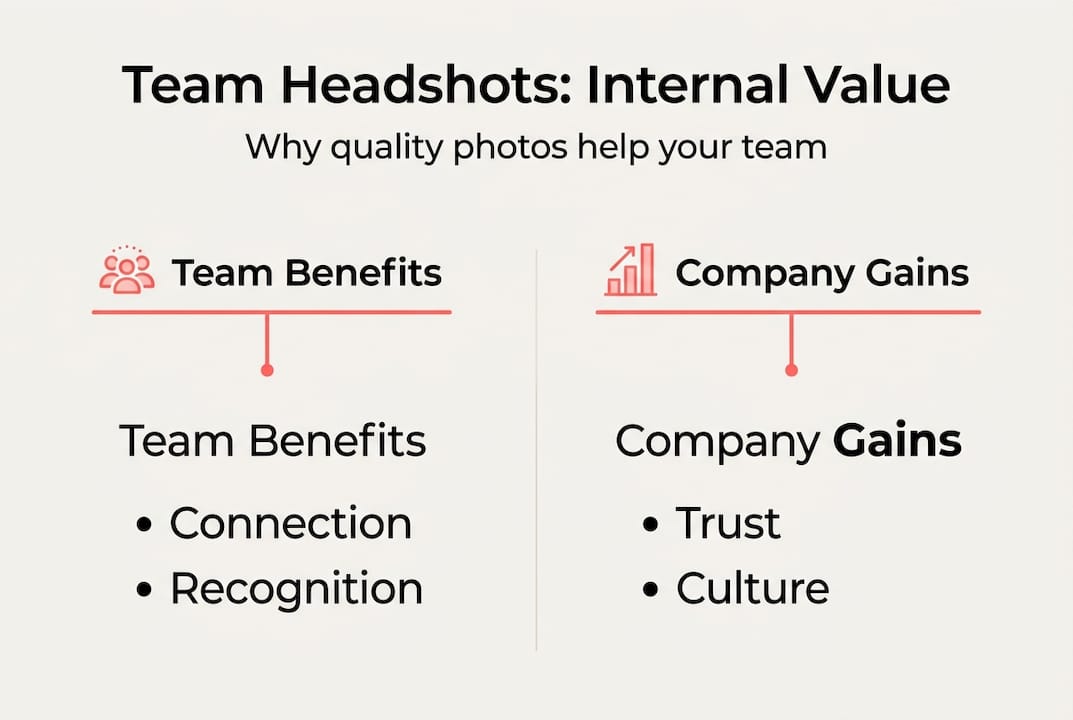
Stat to remember: According to workplace research, employees who feel connected to their team are significantly more productive and less likely to disengage. Visual familiarity is one of the underrated contributors to that sense of connection, and it costs far less to invest in than most engagement programmes.
Practical steps for implementing impactful team headshots
Understanding the benefits is one thing. Actually rolling out a coordinated headshot programme across your organisation is another. Here is where most companies either nail it or quietly drop the ball.
Start with the right photographer. Not every portrait photographer understands what corporate headshots need to accomplish. Look for someone with experience making headshots stand out for professional audiences, someone who can work efficiently with groups, maintain consistent lighting setups across multiple subjects, and make people feel comfortable in front of a camera (because most people do not love being photographed at work).
Here are the key factors to evaluate when selecting a photographer:
Corporate portfolio: Do their existing samples look like they belong on professional websites and LinkedIn pages?
On-location capability: Can they come to your office and set up efficiently without disrupting your team’s schedule?
Workflow and turnaround: How quickly will you receive edited images? Are files delivered in web-ready and print-ready formats?
Style consistency: Can they demonstrate consistent results across a group of people photographed across multiple sessions or days?
For best corporate headshot outcomes, the logistical side matters as much as the photography itself.
Team headshot planning reference
Planning element | Recommendation |
Session length per person | 10 to 15 minutes for a focused session |
Number of final photos per person | 2 to 3 edited selects minimum |
Background choice | Neutral grey, white, or branded office setting |
Scheduling lead time | 2 to 4 weeks to coordinate team availability |
File formats requested | JPEG web-optimised + high-resolution for print |
Update cycle | Every 1 to 2 years, or after rebranding |
Coordination is where large-scale shoots succeed or fall apart. Have a point person from your HR or marketing team manage scheduling. Send a clear brief to staff explaining what to wear, where to go, and how long it will take. Uncertainty creates anxiety, and anxious people take awkward photos.
Pro Tip: Ask your photographer to provide a brief style guide you can share with team members before the session. When everyone knows what colours photograph best and what to avoid (thin stripes, logos, overly casual wear), the results are dramatically more cohesive. Reviewing guidance on preparing for a headshot session can help your whole team show up ready.
Finally, build consistency into your ongoing process. When new staff join, they should receive their headshot within the first few weeks. When someone’s appearance changes significantly, their photo should be updated. Treat headshots as a living part of your brand, not a one-time project.
What most companies overlook about team headshots
Here is my honest perspective after years of photographing teams across Calgary. Most companies treat a headshot session as a checkbox. “Done, we have photos.” They schedule one afternoon, photograph whoever is available, and then leave those images untouched for four or five years while their team changes, their brand evolves, and their industry moves on.
That approach does not protect your brand. It actively works against it.
Generic, mismatched, or visibly outdated headshots send a message you probably do not intend. They suggest a company that does not pay attention to details. And in professional services, where clients are essentially buying trust and judgement, that perception has real consequences. Your team page should not look like it was assembled in three different decades.
The deeper issue is that many executives view headshots as a cost rather than an investment. But consider what a single well-converted client relationship is worth to your firm. If polished, consistent headshots increase your conversion rate on your website by even a small margin, the return is substantial. Best headshots advice consistently points to the same conclusion: the quality of your visual presentation shapes how seriously people take you before any conversation begins.
There is also something to be said for team morale. When you invest in professional photos for every member of your team, regardless of seniority, you are telling your people that they matter. That they are worth representing well. I have seen firsthand how a simple, well-done headshot session can shift the energy in an organisation. People stand a little taller. They update their LinkedIn profiles. They feel proud to represent the company. That is not a small thing.
My suggestion is this: build headshots into your annual or biennial culture calendar, the same way you plan team events or performance reviews. Make it a moment your team actually looks forward to. Keep the session efficient, warm, and genuinely stress-free. And treat the images you produce as the brand assets they really are.
Connect with Calgary’s headshot experts
If this article has made you think differently about your company’s headshots, the next step is simple. Let’s talk about what your team needs.
[
At Jeff B Photography, we specialise in exactly this: efficient, on-location headshot sessions for Calgary businesses that produce consistent, polished results across entire teams. Whether you have five people or 150, we build the experience around your schedule, your brand, and your people. No awkward posing, no guesswork, just images your whole team will actually be proud to use. Reach out to our Calgary headshot specialists today to talk through options and get a session on the calendar. Your brand is worth showing up for.
Frequently asked questions
How often should team headshots be updated?
Team headshots should be updated every one to two years, or sooner when there are significant staff changes, a rebrand, or a noticeable shift in company culture. Keeping images current and consistent is one of the most important factors in maintaining a professional appearance.
What background is best for team headshots?
Simple, clean backgrounds work best because they keep the focus on your people and avoid distracting from the professional impression you want to create. Background and setting advice generally favours neutral tones that complement most brand colour schemes.
What should team members wear for corporate headshots?
Team members should wear professional attire that aligns with your company’s brand and avoids busy patterns, logos, or colours that clash with your visual identity. A clear attire guide for groups helps ensure everyone looks cohesive without feeling like they are wearing a uniform.
Can team headshots help remote teams feel connected?
Absolutely. Headshots help remote team members put a face to a name, which is one of the simplest ways to foster a sense of team connection across distributed groups. Visual familiarity reduces friction in collaboration and helps new employees integrate faster, even when they rarely meet in person.
Recommended


Comments