
Commercial photography terms for standout Calgary branding
- Jeff Borchert
- Apr 17
- 8 min read
TL;DR:
Understanding photography terms like aperture and lighting helps clients communicate their brand vision effectively.
Proper lighting and focal length choices create approachable, polished images that boost trust and credibility.
Using shared vocabulary with photographers ensures intentional, cohesive branding across all business visuals.
Not all corporate headshots are created equal, and the difference often comes down to a single conversation. When you walk into a session knowing what “aperture,” “compression,” or “three-point lighting” actually means, you stop being a passive subject and become a true creative partner. That shift produces images that feel alive, on-brand, and genuinely useful across your LinkedIn profile, website, and marketing materials. This guide breaks down the essential commercial photography terminology every Calgary business professional should know, with real examples and practical tips to help you get the most out of every session.
Table of Contents
What is commercial photography? Essential definitions for Calgary businesses
Understanding lighting: Making your business portrait stand out
Camera settings and posing: Demystifying technical terms for business portraits
From studio to website: How commercial photography terms impact your Calgary brand
Why mastering photography terms sets Calgary businesses apart
Take your Calgary brand further with expert commercial photography
Key Takeaways
Point | Details |
Know the terminology | Learning core photography terms helps you get better results and communicate clearly with your photographer. |
Lighting shapes your image | Different lighting setups dramatically affect how approachable and authoritative your brand visuals appear. |
Collaboration is key | Understanding terminology empowers you to work alongside your photographer for truly impactful Calgary business images. |
Branding impact | The right terminology leads to visuals that resonate online, in marketing, and across all platforms. |
What is commercial photography? Essential definitions for Calgary businesses
Commercial photography is any photography created for business purposes. That covers everything from corporate headshots on your company website to product shots in a sales catalogue. For Calgary businesses, the most relevant categories are headshots, branding imagery, and event photography.
It helps to know the difference between these right away. A headshot is a tight, professional portrait focused on your face and shoulders, designed to represent you as an individual. A branding image is broader, often incorporating your workspace, tools, team, or lifestyle to tell a fuller story about your business. Understanding the role of a corporate photographer means recognising which type of image you actually need before you book.
Once you understand the category, a few technical terms become immediately useful:
Focal length: The distance between the camera lens and the sensor, measured in millimetres. Longer focal lengths (like 85mm to 135mm) compress facial features flatteringly.
Aperture: The opening in the lens that controls light and depth of field. A wider aperture (lower f-number) softens the background.
Compression: A visual effect created by longer lenses that makes facial proportions look natural and balanced.
Three-point lighting: A classic setup using a key light, fill light, and rim (or hair) light to shape the subject.
Framing: How the photographer composes the shot, including how much of your body is visible and where you sit in the frame.
“For corporate headshots, use an 85mm to 135mm focal length for flattering compression effect, an aperture between f/4 and f/8 for sharp eyes with a soft background, three-point lighting with the key at 45 degrees, fill to soften shadows, and rim for separation, along with eye-level camera placement and chest-up framing.”
These terms are not jargon for jargon’s sake. They are the shared vocabulary that helps you tell your photographer exactly what you want, and helps them deliver it with confidence.
Understanding lighting: Making your business portrait stand out
Lighting is the single greatest influence on how you look and feel in a business portrait. Get it right, and you look polished, trustworthy, and approachable. Get it wrong, and even the best outfit and biggest smile won’t save the image.
The best corporate headshot tips almost always lead back to lighting setup. Here are the three lights in a classic three-point setup:
Key light: The main light source, typically placed at a 45-degree angle to your face. It establishes the overall brightness and direction of light.
Fill light: A softer light placed on the opposite side to reduce harsh shadows. It keeps your face readable without flattening the image.
Rim light (or hair light): Positioned behind you to create separation between your shoulders and the background. This adds depth and dimension.
Beyond the three-point setup, photographers use named lighting patterns to create specific moods. Rembrandt lighting places a small triangle of light on the shadowed cheek, creating a classic, painterly quality. Broad lighting illuminates the wider side of the face, which can appear more open and energetic. Short lighting illuminates the narrower side, which is generally more slimming and dramatic.
Lighting setup | Best use case | Mood and feel |
Three-point lighting | Professional headshots, team photos | Clean, polished, approachable |
Rembrandt lighting | Executive portraits, creative professionals | Sophisticated, artistic, bold |
Broad lighting | Energetic brand imagery, speakers | Open, confident, dynamic |
Short lighting | Individual portraits, creative brands | Sculpted, refined, dramatic |
For professional headshot sessions, a large softbox as the key light combined with a reflector fill produces a clean, approachable result that works beautifully across most skin tones. Avoiding harsh shadows is especially important when your goal is projecting approachable authority.

Pro Tip: When booking your session, ask your photographer which lighting pattern they plan to use. Mentioning that you want a “clean, softbox-lit three-point setup” or a “Rembrandt portrait” immediately signals that you understand the craft and helps them tailor the session to your brand.
Camera settings and posing: Demystifying technical terms for business portraits
You don’t need to know how to operate a camera to benefit from understanding its settings. When you can follow along with your photographer’s technical decisions, you stay grounded and confident in front of the lens rather than wondering why they’re fiddling with dials.
Here are the four most relevant camera settings for business portraits:
Focal length: As mentioned, 85mm to 135mm is the sweet spot for flattering facial compression in headshots. It avoids the distortion of wide-angle lenses, which can make noses appear larger and faces wider.
Aperture: Between f/4 and f/8 is ideal. This range keeps your eyes tack-sharp while gently softening the background so nothing competes with your face.
ISO: This measures the camera’s sensitivity to light. A lower ISO produces a cleaner image. In well-lit studio or outdoor settings, your photographer will typically keep it low.
Shutter speed: For portraits, this is less of a concern as long as the subject (you) stays reasonably still. Your photographer manages this setting automatically in most headshot scenarios.
On the posing side, a few terms are worth knowing. Eye-level framing means the camera is positioned at your eye height rather than above or below, which produces the most natural and equal perspective. Chest-up framing includes your face, neck, and upper body, which gives context to your professional look without losing intimacy. Posing for headshots is about small adjustments: a slight chin tilt, shoulder rotation, or lean forward can transform a stiff shot into something that radiates confidence.
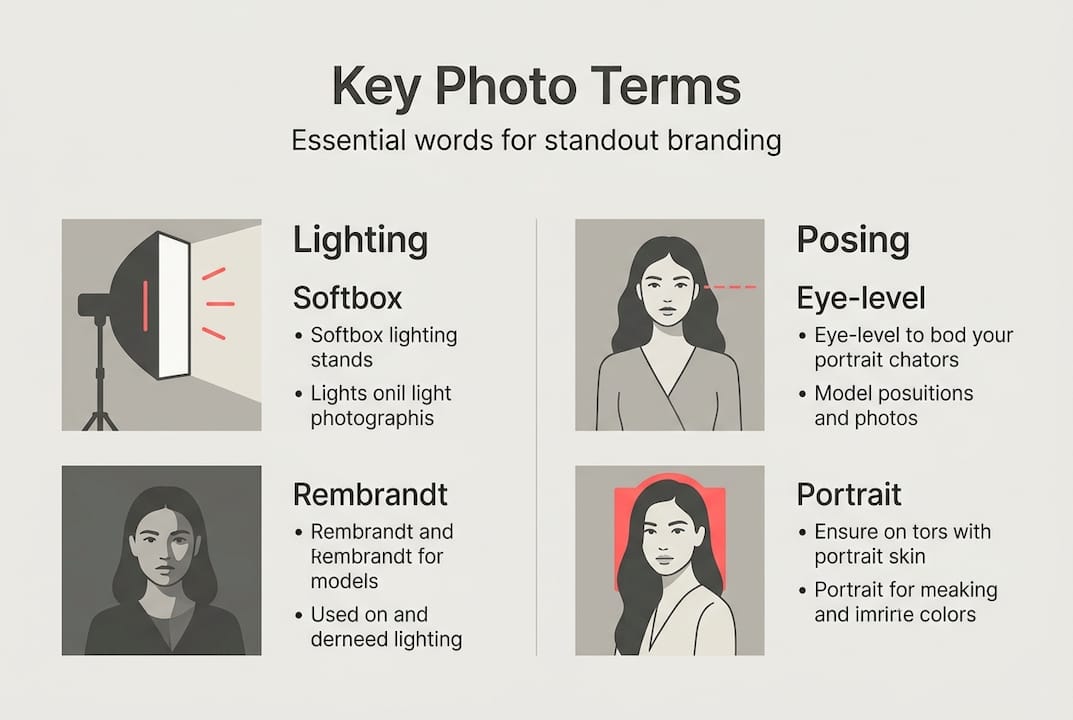
Knowing the difference between headshots and portraits also helps here. A portrait can be more relaxed and environmental, while a headshot is intentionally constructed. Both require posing guidance, but the energy is different.
Pro Tip: Before your session, practise one or two natural expressions in a mirror. You’re not performing, you’re relaxing into your own face. When you arrive already familiar with how you look at ease, the photographer can focus on the technical work instead of coaching you through nerves.
From studio to website: How commercial photography terms impact your Calgary brand
Once you speak the language, the difference in your business visuals becomes clear. Here’s a real-world scenario. A Calgary consultant books a headshot session and simply says, “I want something professional.” The photographer delivers a competent but generic result. Now imagine the same consultant says, “I’d like short lighting for a polished feel, a dark background for contrast, and chest-up framing. I want it to feel confident but approachable, not overly formal.” Suddenly, the photographer has a precise creative brief and the resulting images fit directly into the consultant’s brand.
The impact of that shared vocabulary shows up everywhere:
Website: A properly lit, compressed headshot at the right focal length looks credible and inviting on an About page. A distorted wide-angle photo undermines trust without the viewer even knowing why.
LinkedIn: Profile photos with clean three-point lighting and soft backgrounds consistently perform better for connection requests and profile views.
Print materials: Understanding colour, contrast, and background helps ensure your headshot translates well to print without looking washed out or pixelated.
Social media: Consistent lighting and framing across a team creates a cohesive brand identity that makes your business look organised and intentional.
Without clear terminology | With clear terminology |
Generic, unflattering lighting | Custom lighting matched to your brand mood |
Wide-angle distortion | Flattering compression at 85mm to 135mm |
Inconsistent team headshots | Unified style across your entire organisation |
Background competes with subject | Background chosen deliberately for contrast |
Using approachable authority lighting (avoiding harsh shadows while maintaining dimension) is a practise that professionals use to build trust through imagery. Whether you’re taking professional headshots for a solo personal brand or coordinating a full team, these decisions compound into a stronger overall presence. Understanding people headshots as a strategic tool rather than a box to check is where Calgary businesses start to pull ahead.
Why mastering photography terms sets Calgary businesses apart
Here’s something I’ve seen play out in session after session: the clients who arrive with a working knowledge of photography terms walk away with better images. Not because they micromanage the process, but because the conversation goes deeper, faster.
I once worked with two executives from the same company on the same day. One arrived with a vague request for “something good for LinkedIn.” The other walked in and said, “I’m thinking short lighting, neutral grey background, aperture wide enough to separate me from the background.” Same studio. Same equipment. Completely different creative energy. And yes, completely different results.
Knowing the terms is a starting point. Making them part of your ongoing brand strategy is where headshots that stand out actually get created. When both you and your photographer share a vocabulary, creativity flows in both directions. You contribute ideas, the photographer refines them technically, and the result feels like a genuine collaboration rather than a transaction.
In Calgary’s competitive professional market, that level of intentionality in your visual brand is a quiet but powerful advantage.
Take your Calgary brand further with expert commercial photography
You now have the vocabulary to walk into any session with clarity and confidence. That knowledge is genuinely exciting because it means your next set of images can be exactly what your brand deserves.
[
At Jeff B Photography, we build every session around collaboration. Whether you’re refreshing your Calgary headshots or creating full branding imagery for your business, we speak your language and help you translate your vision into images you’ll actually use. The process is guided, efficient, and designed to feel easy even if you’re not a fan of being in front of a camera. Let’s create something that truly represents you.
Frequently asked questions
What is the difference between commercial and corporate photography?
Commercial photography covers all images used for business promotion, while corporate photography often focuses on portraits, headshots, and company culture visuals. Both serve your brand, but corporate photography is typically more people-centred.
Why does lighting matter in a professional headshot?
Lighting shapes your face, sets the mood, and ensures your brand image appears polished and trustworthy. The right lighting setup avoids harsh shadows that can make a professional appear unapproachable.
Which camera setting most affects how I look in a headshot?
Focal length is the most impactful. A focal length between 85mm and 135mm produces flattering facial proportions and a soft background blur that keeps the focus on you.
How do I communicate my brand vision to a photographer?
Use key terms such as lighting style, background type, and desired mood to guide your photographer before and during your session. The more specific you are, the more intentional and on-brand your images will be.
Recommended


Comments