
Photo-driven branding: what it means and how to use it
- Jeff Borchert
- May 5
- 9 min read

TL;DR:
Most teams rely solely on headshots, missing the strategic value of a comprehensive photo-driven branding system.
Implementing a purposefully planned, consistent image library enhances brand cohesion across all marketing channels and touchpoints.
Most corporate teams think they’ve nailed their brand visuals because they’ve done a round of headshots. I get it. Headshots matter, and they’re a great starting point. But if you’re stopping there, you’re leaving an enormous amount of brand value on the table. Photo-driven branding is something much bigger, much more strategic, and honestly, much more exciting than a single session in front of a camera. This guide breaks down exactly what photo-driven branding is, how to build it into your organisation’s marketing system, and why getting it right gives your team a genuine competitive edge.
Table of Contents
Key Takeaways
Point | Details |
Photo-driven branding defined | It’s a strategic, purposeful approach to imagery that expresses your brand values and supports your marketing. |
Beyond headshots | A successful photo-driven brand uses a diverse image library tailored for different touchpoints and audiences. |
Consistency and governance | Systematic planning and governance maintain authenticity and brand coherence across all visuals. |
Operational framework | You need to plan images by business need, define aesthetic standards, and use a governed asset library. |
Defining photo-driven branding: beyond pretty pictures
Let’s be direct about something. A polished headshot is not a brand strategy. A few nice office photos posted on Instagram don’t constitute a visual identity. Photo-driven branding is a commitment to using imagery purposefully, consistently, and strategically across every touchpoint your audience encounters.
In practice, brand photography sessions involve strategic image planning that translates brand values, personality, and positioning into a full library of usable assets including portraits, lifestyle and working images, environmental shots, and detail photography. That’s a completely different scope than booking a one-hour headshot session for your leadership team once every two years.
Think about what your brand actually communicates across all your channels. Your LinkedIn company page, your website’s About section, your email newsletters, your trade show displays, your sales decks. Each of these spaces tells a story. Photo-driven branding ensures those stories are visually consistent and intentional. To explore what this looks like in practice, branding photos explained is a solid resource for seeing the real scope of the work.
Here’s a comparison that makes the difference very clear:
Basic photography approach | Photo-driven branding approach |
One-off headshot sessions | Planned library of diverse image types |
Images chosen for aesthetics only | Each image mapped to a specific business purpose |
No visual consistency guidelines | Defined visual style and colour palette |
Reactive (shoot when needed) | Proactive (shoot aligned to campaign calendar) |
Assets stored informally | Organised, governed asset library |
Focused on individuals | Covers team, environment, lifestyle, product |
“Strategic brand imagery is designed around where the brand shows up and ensuring each image has a purpose, supporting marketing ecosystem needs rather than just looking good.” Strategic brand imagery is what separates brands that look polished from brands that feel cohesive and real.
The concept of branding in photography goes beyond composition and lighting. It’s about intention. Every image in a photo-driven brand library earns its place because it serves a specific role in helping your audience understand who you are and why you matter.
How photo-driven branding works in business settings
Once you understand what photo-driven branding actually is, the next question is how you actually roll it out inside a real business. This is where a lot of teams stumble. They understand the concept but have no system for executing it.
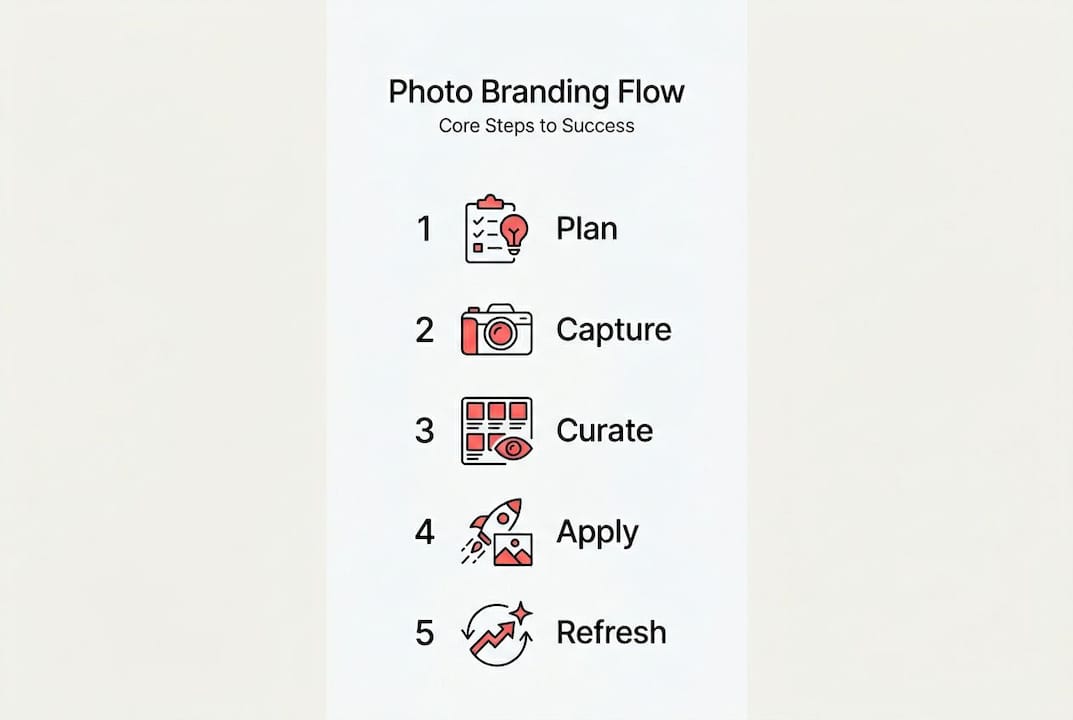
The strongest approach is to treat image creation as a business system for consistency: plan the shoot around marketing goals, define the visual direction, and then maintain consistency via guidelines and an asset library. That reframe is everything. You’re not booking a photographer because your website photos look old. You’re creating a repeatable system that keeps your visual brand fresh, relevant, and aligned with where your marketing is headed.
Here’s how that looks in practice for a Canadian corporate team or marketing department:
Align photography with brand guidelines. Before you ever book a session, make sure you have a clear visual direction. Colours, tone, setting preferences, styling notes. The photos need to reflect the brand, not just the photographer’s default aesthetic.
Map images to marketing needs. What campaigns are coming up in the next six months? What does your website need? What’s missing from your social content calendar? Build your shoot list from actual marketing gaps.
Define your visual look. Bright and airy? Bold and dramatic? Candid and natural? This should be documented so every future session builds on the same foundation.
Build an asset library. Photos don’t live in one person’s email inbox. They live in an organised, accessible system your whole team can use, from the social media manager to the executive assistant pulling together a board presentation.
Establish governance. Who approves new images? What editing standards apply? How long before assets are considered out of date? These questions matter more than most teams realise.
Photo branding frameworks can help you structure this process if you’re building it from scratch. Having a repeatable framework means that even when team members change or campaigns shift, the visual system stays intact.
Marketing channel | Image types needed | Refresh frequency |
LinkedIn company page | Team, leadership, culture | Annually or when team changes |
Website | All types: portraits, lifestyle, environment | Every 2 to 3 years minimum |
Social media | Lifestyle, detail, candid, event | Ongoing, monthly or quarterly |
Email marketing | Campaign-specific, product, lifestyle | Per campaign |
Sales materials | Leadership, product, client environments | Annually |
Pro Tip: Build your shoot list by auditing your existing marketing materials first. Note every spot where you’ve used a stock photo, an old image, or nothing at all. That gap list becomes your next photography brief.
Branding photo success consistently comes back to this idea of planning. Teams who approach photography as a one-time task will always feel like they’re catching up. Teams who build it into their marketing rhythm feel confident and ready.
Building an effective photo-driven brand library
Your brand library is the engine that powers everything. Without it, even the most beautifully shot images get buried in a Dropbox folder and forgotten. With it, your team has a go-to resource that makes every piece of content faster to produce and more consistent in appearance.
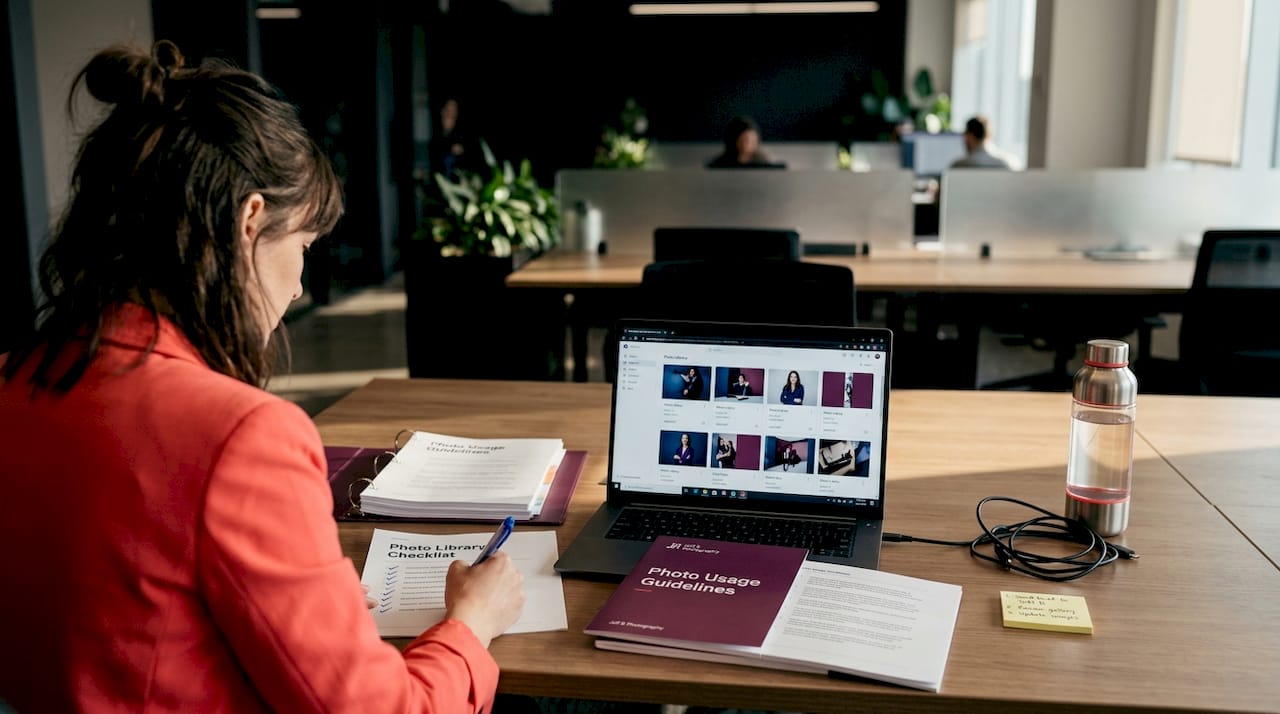
Building a strong brand library means creating a range of asset types that cover every scenario your marketing team encounters, including portraits, lifestyle and working images, environmental shots, and specific detail photography. Think of it as stocking a visual pantry. You want ingredients for every recipe, not just one type of dish.
Here are the core image categories every corporate brand library should include:
Leadership and team portraits. These are your people. Headshots, yes, but also approachable and authentic images that show personality, not just professionalism. Team branding photo ideas can spark some creative directions for getting more from your team sessions.
Workplace and environment shots. Your office, your workspace, your neighbourhood. These images ground your brand in a real place and help audiences understand your culture.
Lifestyle and working images. Candid shots of your team in action. Meetings, collaborations, client interactions. These feel real because they are real.
Product and service detail shots. Close-ups, textures, specific tools or materials. These give context and credibility to what you offer.
Event and community images. Conferences, team events, networking gatherings. These reinforce that your brand is active and connected.
Here’s a practical numbered process for building your library from the ground up:
Audit your current image bank. Identify what you have, what’s outdated, and what’s missing entirely.
Map images to upcoming campaigns. Prioritise shooting what you actually need in the next quarter before filling in the gaps.
Schedule a foundational shoot. Book a session that captures core portraits, environment shots, and lifestyle images in a single day.
Plan seasonal or campaign refreshes. Schedule smaller top-up shoots quarterly or around major launches.
Govern and organise as you go. Tag, label, and file every image as it comes in. Don’t let the library become a chaos folder.
Pro Tip: Mix staged and candid imagery intentionally. Staged shots give you polish and control. Candid shots give you warmth and authenticity. A library with only one type will feel flat. The benefits of branding photography become most obvious when you start using diverse image types across your channels.
Also consider your team’s growth trajectory. If you’re scaling quickly, bake photography into onboarding so new hires are added to your library without a major production each time. Business branding photography works best as an ongoing practise, not a once-a-decade event.
Balancing authenticity, governance, and evolving image standards
Here’s a challenge every Canadian marketing team eventually faces: how do you stay authentic while also maintaining brand consistency? And how do you set standards that will hold up as visual trends evolve?
The answer starts with defining authenticity for your brand specifically. Not every brand needs the same look. Some companies thrive with polished, high-production imagery. Others connect better with their audience through raw, candid, documentary-style shots. Neither approach is wrong. But you need to decide which one yours is and document it.
There are a few essential elements any image governance policy should cover:
Staging guidelines. How much staging is acceptable? Are lifestyle images allowed to be directed, or should they be purely observational?
Editing standards. What level of retouching is permitted? Colour grading? Background replacement? Define your limits clearly.
AI imagery policies. This is increasingly relevant. If your brand values authentic, real-world photography, you should explicitly state that AI-generated or heavily AI-modified images are not permitted in your visual library.
Approved usage rules. Where can images be used? Who can download and share them? What requires formal approval?
Expiry and refresh timelines. Images age. People change. Set review dates so outdated visuals don’t linger in your active library.
The Destination Canada imagery guidelines are a great real-world example of how an organisation can define authentic image standards at scale. Their approach prioritises photos that feel real and spontaneous, avoids overly staged settings, limits heavy editing, and excludes AI-generated imagery entirely.
“Authenticity in brand photography isn’t just a preference. It’s a governance decision that requires documentation, communication, and consistent enforcement across every team member and agency partner who touches your visual assets.”
This matters especially in the Canadian market, where audiences are increasingly savvy about spotting staged, inauthentic content. Brands that use real moments, real people, and real environments consistently outperform those that lean on stock photos or over-produced imagery. The connection is genuine, and audiences feel it.
What most teams still get wrong about photo-driven branding
I’ve worked with a lot of teams on their visual branding, and the most common mistake I see has nothing to do with lighting or camera angles. It’s the absence of a system. Teams invest in a single great shoot, get excited about the results, post everything in the first two weeks, and then go radio silent visually for the next eighteen months.
That’s not a strategy. That’s a sprint followed by a long rest.
The business impact of branded photography is cumulative. It builds over time as your audience sees consistent, recognisable visual language across every channel. One great shoot won’t achieve that. A sustained, systematised approach will.
Another thing I see often: teams that invest heavily in leadership headshots but completely neglect lifestyle, culture, and environment images. The result is a brand that looks professional but feels cold. Your audience doesn’t just want to see who’s in charge. They want to feel what it’s like to work with you, to be in your world. That emotional resonance comes from the full library, not just the portraits.
Finally, I want to gently push back on the idea that photo-driven branding is only for large enterprise teams with big marketing budgets. Some of the most effective brand libraries I’ve helped build were for small and mid-sized Calgary businesses who simply committed to planning their photography intentionally. You don’t need a massive budget. You need a clear plan, a consistent visual direction, and the willingness to treat photography as an ongoing investment rather than a one-time expense.
Elevate your brand visuals with expert photography
Photo-driven branding is one of those things that sounds straightforward but genuinely benefits from having an experienced eye involved from the start. Getting the right mix of images, planning for your actual marketing needs, and maintaining consistency across a growing library takes both creative skill and strategic thinking.
[
At Jeff B Photography, I work with corporate teams and marketing departments across Calgary to build the kind of visual libraries that actually get used. Whether you’re starting with professional headshots for your leadership team and growing from there, or you’re ready to plan a full brand shoot that covers everything from candid team moments to detailed environment photography, I’d love to help you get there. The goal is always the same: images you’re proud to put in front of your audience, again and again.
Frequently asked questions
What makes photo-driven branding different from basic headshots?
Photo-driven branding involves building a strategic library of images that express brand values and support specific marketing goals, whereas basic headshots address only individual portraits without a broader visual strategy.
How do we ensure photo-driven branding looks authentic and not staged?
Use spontaneous, minimally staged photos and set clear brand governance to limit heavy editing and, if appropriate for your brand, explicitly prohibit AI-generated imagery.
What types of images should be included in our brand library?
Your library should include a mix of leadership, team, lifestyle, environment, product, and detail images that collectively tell your brand story across every marketing channel.
How is image consistency maintained across channels?
By treating image creation as a business system, including shoot planning around marketing goals, defined visual direction, and a governed asset library accessible to all team members.
Recommended
Comments