Streamline your event photo coverage for real results
TL;DR:
Effective event photography requires clear objectives, targeted shot lists, and understanding audience needs.
Successful coverage depends on detailed planning, logistical coordination, and real-time communication during the event.
Authentic, candid images are now favored over overly posed photos to better tell your brand story.
You’ve planned every detail of your Calgary corporate event, from the catering to the keynote, and then the photos come back looking like an afterthought. Blurry networking shots, missed speaker moments, and not a single clean image of your branded signage. It’s a frustrating outcome that happens more often than it should, and it’s entirely avoidable. With a clear, step-by-step coverage process, your event photos can do real work for your brand long after the room clears out. This guide walks you through exactly how to plan, execute, and deliver event photo coverage that captures the moments and details that actually matter.
Table of Contents
Key Takeaways
Point | Details |
Clarify objectives early | Define must-have moments and branding needs upfront to guide your coverage. |
Balance candids with posed shots | A 70/30 split favours authenticity while still serving your marketing goals. |
Plan logistics for efficiency | Confirm timelines, team roles, and deliverables to prevent last-minute confusion. |
Leverage post-event assets | Use event images promptly for marketing and internal reports to maximize impact. |
Clarifying objectives and coverage requirements
Now that you know what could go wrong, let’s break down how to set clear goals for your event photo coverage.
The most common mistake I see with corporate event photography is treating it as a single deliverable rather than a layered strategy. Every event has multiple audiences, multiple purposes, and multiple moments that need to be captured with intention. Starting with clear objectives is the foundation of everything else.
Before your photographer even arrives on site, you need to know what success looks like. Ask yourself: who is the audience for these photos? Are they going on your LinkedIn company page, in an annual report, in a post-event email to attendees, or on your website’s about page? Each use case calls for a slightly different mix of imagery.
Here’s a practical breakdown of the photo types to prioritise at most Calgary corporate events:
VIPs and speakers in context: Not just headshots at a podium, but images that include audience reactions, room scale, and the energy of the moment.
Branding details: Your step-and-repeat backdrop, sponsor signage, table centrepieces with your logo, and any branded collateral on display.
Candid networking moments: Genuine laughter, real conversations, and authentic human connection that makes your organisation look approachable.
Establishing shots: Wide-angle images that show the room at its fullest, conveying scale and production value.
Production details: Lighting rigs, floral arrangements, food displays, AV setups. These prove the care that went into your event.
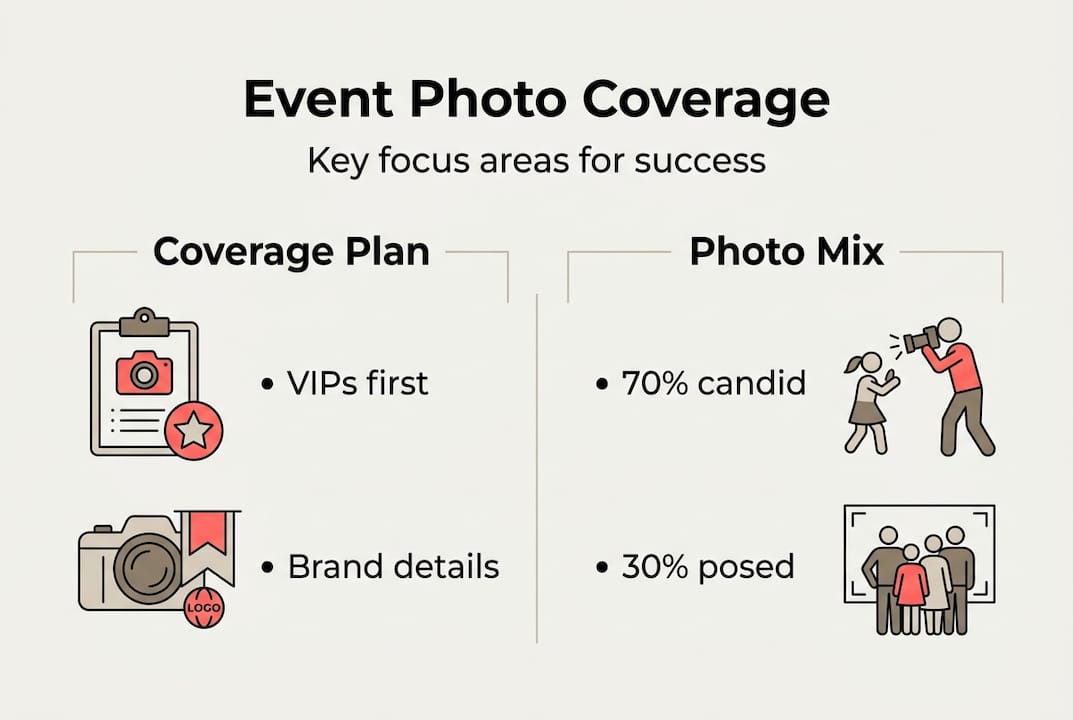
A well-structured event shoot prioritises VIPs, branding details, and candids using a 70/30 candid-to-posed ratio, which is adjustable based on your corporate needs and marketing goals. A product launch might lean more heavily on branding shots, while a team recognition dinner calls for warm, candid storytelling.
Understanding Calgary event photography impact is also worth reading before your next event. The images you capture today can anchor your brand story for months to come.
Pro Tip: Write your shot list as a set of outcomes, not just locations. Instead of “get a photo of the stage,” write “capture the keynote speaker with a full audience visible in the frame.” That language guides a photographer’s instincts toward what you actually need.
Defining your audience expectations up front also helps you avoid a common trap: covering too much, too shallowly. A focused list of twenty essential shots will deliver better results than a vague request for “everything.” Strong corporate photography strategies always begin with this kind of honest scoping conversation.
Preparing for success: Planning, logistics, and team coordination
Once your objectives are clear, smooth execution depends on careful planning and strong communication.
The gap between a good shot list and great event coverage is logistics. You need your photographer to know the venue, the schedule, the key players, and the branding priorities before they walk in the door. This is not a briefing you can leave until the morning of the event.
Start by confirming coverage hours and deliverables in writing. This means specifying:
Start and end time for the photographer, including setup and wrap time.
Key moments that require the photographer to be in specific locations (e.g., the awards portion, the ribbon-cutting, the group photo).
Restricted areas or access requirements, such as VIP-only rooms or media credentials.
Primary contact on site so the photographer can quickly confirm priorities if things shift.
You should also communicate branding specifics clearly. Share your brand colour palette, your logo file, and photos of your signage in advance. Your photographer can use these references to ensure the final images align with your visual identity, not just capture the room.
Industry benchmarks show you can expect 30-50 edited images per hour of coverage. For a two-hour event, that’s roughly 60 to 120 polished images. A full-day conference can yield 200 to 500 edited shots from thousands of raw captures culled with AI-assisted or manual selection workflows.
Here’s a helpful comparison for understanding deliverable options:
Deliverable type | Typical timeline | Best suited for |
Highlight preview set | 24 to 72 hours | Social media, email blasts |
Full edited gallery | 3 to 7 business days | Website, press, internal use |
Same-day selects | Day of event | Live social posting, events with media |
Raw file delivery | Negotiated separately | In-house editing teams |
Check out these event photography prep tips for a deeper look at how to structure your pre-event communication so nothing falls through the cracks.
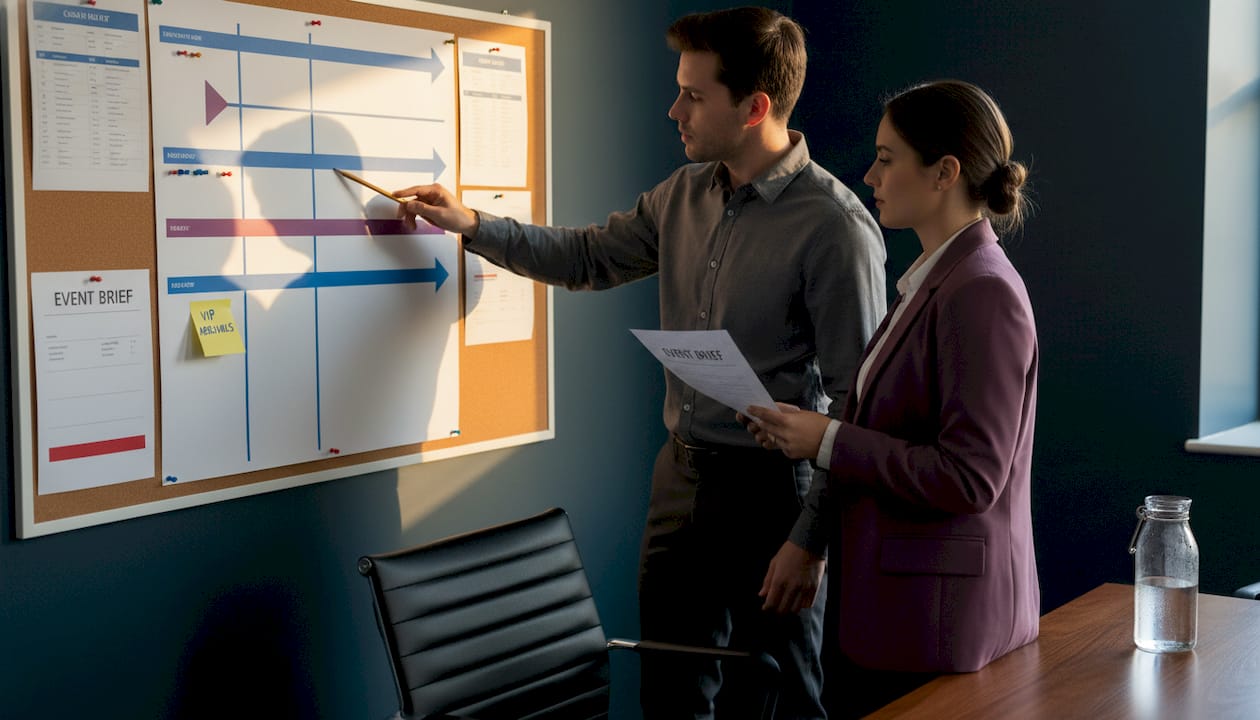
Pro Tip: Create a one-page event brief for your photographer. Include the event name, timeline, key contacts, branding priorities, must-have shots, and any no-go zones. It takes 20 minutes to write and saves hours of confusion on the day.
Strong logistics also include confirming who makes real-time decisions on the day. If a key executive doesn’t show up, or the programme runs 30 minutes long, your photographer needs to know who to check in with. Designate one point of contact and make sure that person has the shot list in hand.
Executing the event photo coverage process step by step
With your plan and team in place, here’s how to carry out coverage that meets every objective.
Day-of execution is where preparation either pays off or falls apart. I’ve found that the most successful event shoots follow a consistent rhythm, even when the schedule shifts. Here’s the process that works, laid out as clearly as I can make it:
Arrive early for venue walkthroughs. Scout the light conditions, confirm branding placement, and identify the best vantage points for key moments before guests arrive.
Capture establishing shots first. Get the room before it fills up. Empty rooms with your branding on full display are some of the most useful images you’ll receive.
Cover VIP arrivals and speaker prep. These moments are often fleeting and set the tone for your entire gallery.
Shift into candid mode during networking and sessions. Stay unobtrusive. Move through the room steadily, looking for genuine moments rather than staged ones.
Coordinate any formal group or posed shots during natural breaks. Meal service, coffee breaks, and transitions are ideal for pulling key people together without disrupting the flow.
Close with detail shots and room-after images. Awards on the table, branded swag, signage in good light. These round out your gallery beautifully.
The tension between candid and posed photography is real, and both serve important purposes. Candid imagery brings authentic storytelling and genuine emotion. Posed shots create polished, branded assets for your marketing toolkit. Corporate events benefit from leaning approximately 70% candid and 30% posed, though a product launch or awards ceremony might shift that balance toward more structured imagery.
Here’s a sample hourly breakdown to give you a realistic sense of shot distribution:
Event hour | Primary focus | Approx. shots captured |
Hour 1 | Arrivals, room details, branding | 150 to 200 raw |
Hour 2 | Keynote, audience reactions | 200 to 250 raw |
Hour 3 | Networking, candids, group shots | 180 to 220 raw |
Hour 4 | Wrap, awards, closeout details | 100 to 150 raw |
“A great event photographer doesn’t just document what happened. They capture how it felt to be in the room.”
Strong branding photo tips can also guide how you present your branded elements visually, making it easier for your photographer to prioritise the right details in real time.
For posing and candid guidance that applies beyond just events, it’s worth building your team’s comfort with cameras in advance. Even a five-minute briefing before a group photo can dramatically improve the results.
Post-event workflow: Selection, delivery, and maximising results
After the event wraps up, the most important work begins: turning photos into marketing assets.
Here’s something a lot of event planners don’t fully appreciate until it’s too late. The raw images from your event are not the product. The edited, colour-corrected, carefully selected final gallery is. And the workflow that gets you from one to the other matters enormously.
A professional corporate photographer workflow typically looks like this:
Ingest and backup: All raw files are immediately backed up to multiple drives. No exceptions.
AI-assisted culling: Modern tools can scan thousands of raw frames and flag the strongest selects based on sharpness, expression, and composition. This dramatically reduces turnaround times.
Manual review: A skilled photographer reviews the AI selects and makes final editorial decisions. This is where instinct and brand knowledge shape the gallery.
Editing and colour grading: Selected images are processed for consistent colour, brightness, contrast, and brand alignment across the entire gallery.
Delivery: The final gallery is shared via a password-protected online gallery or cloud folder, organised and labelled for easy use.
Industry data backs this up: expect 30-50 edited images per hour of coverage, with raw files ranging from 1,000 to 7,000 shots culled down to polished selects. Highlights typically arrive within 24 to 72 hours, and a full gallery lands within 3 to 7 business days.
The rise of AI in post-production is genuinely exciting. AI-accelerated post-production can deliver same-day preview images, giving your marketing team a competitive edge for social media coverage and live event recaps.
Pro Tip: Ask your photographer to tag or organise images by moment or category (arrivals, keynote, networking, details) so your marketing team can find exactly what they need without sorting through hundreds of images. This small step saves real time.
Once your gallery is in hand, think beyond the immediate post-event email. Strong event photos can anchor your next sponsorship proposal, illustrate your culture on your careers page, support your next grant application, and fill your content calendar for weeks. A well-captured two-hour luncheon can generate months of brand-building material. That’s the real value of doing this right.
Rethinking event coverage: Why authenticity is your strongest brand statement
I want to be direct about something, because I think it’s the most important shift event planners can make.
Most organisations still over-index on posed photography. They want a certain “polish” that ends up feeling sterile. Today’s audiences, whether they’re scrolling LinkedIn or opening a conference recap email, respond to images that feel real. A photo of your CEO laughing with a first-year employee at the gala is worth ten formally posed board portraits.
Trends in conference photography consistently favour authenticity and candid storytelling alongside branded shots. The risk of over-curating your event imagery is that it loses the humanity that makes people want to engage with your brand.
That said, authenticity without strategy is just a photo dump. The best event coverage tells a specific story about your organisation’s values, energy, and people. Authentic storytelling in event photography means approaching every event with a narrative intention, not just a camera.
My advice: trust the candids. Let the room breathe in your photos. And brief your photographer on the story you want to tell, not just the moments you want to document.
Simplify your next event with expert photo coverage
Ready to make your next event worry-free?
Working with a Calgary-based specialist means you get someone who understands the pace of local corporate events, the importance of branding in your final gallery, and the genuine value of next-day highlight images your team can actually use right away.
[
At Jeff B Photography, event coverage is built around capturing real moments, key people, and branded details without disrupting the flow of your event. Whether you need Calgary event headshots woven into your corporate gathering or full-event documentary coverage, the process is designed to be seamless from brief to delivery. Visit Jeff B Photography to start planning your next event with a team that’s as invested in your results as you are.
Frequently asked questions
How many photos should I expect from a typical Calgary corporate event?
Most events yield 30-50 edited images per hour of coverage, so a two-hour event typically delivers 60 to 120 polished images, while a full-day conference can produce 200 to 500 selects.
How soon can I expect photo highlights after my event?
Highlight previews are typically delivered within 24 to 72 hours after the event, with the full edited gallery arriving within 3 to 7 business days.
What’s the best mix of candid and posed shots for corporate branding?
A 70% candid to 30% posed ratio gives you authentic storytelling alongside the structured, branded images your marketing team needs for campaigns and communications.
How does AI improve the speed or quality of event photo delivery?
AI-assisted culling and editing tools accelerate post-production significantly, enabling same-day preview delivery and faster access to polished highlight shots after your event.
Recommended
Comments