
Why update headshots regularly: a professional guide
- Jeff Borchert
- May 21
- 9 min read

TL;DR:
Your headshot is often the first impression a potential client or partner encounters, shaping trustworthiness and credibility within milliseconds.
Regularly updating headshots every one to three years or sooner after major changes ensures your professional image stays current and aligned with your brand.
Before you say a single word to a potential client, recruiter, or business partner, your photo has already done the talking. Research shows that judgments form in 100 milliseconds — trustworthiness, competence, likability — all assessed before anyone reads your bio or your credentials. That’s why understanding why update headshots regularly matters so much for professionals and business owners. An outdated photo isn’t just a cosmetic issue. It shapes how people decide whether to trust you, hire you, or reach out at all. This guide breaks down when to refresh, what to watch for, and how to make every update count.
Table of Contents
Key takeaways
Point | Details |
First impressions are instant | Judgments about your credibility form within a fraction of a second, so your photo must be current and polished. |
Update every one to three years | Most branding professionals recommend refreshing your headshot within this window, or sooner when major changes occur. |
Triggers matter more than timelines | Significant career shifts, appearance changes, or brand pivots are reasons to update headshots ahead of schedule. |
Brand consistency builds recognition | Using the same quality image across all platforms reinforces your professional identity and builds audience trust. |
New photos open real doors | Updated headshots drive engagement on LinkedIn and beyond, directly influencing business and career outcomes. |
Why update headshots regularly for your professional brand
Your headshot is often the first thing someone sees before they ever speak with you. On LinkedIn, on your company website, on a speaker bio, on a media pitch. That single image carries enormous weight, and the stakes are higher than most professionals realise.
Outdated photos reduce credibility in professional settings by signalling inattention to detail. Think about it from the viewer’s side: if someone clicks your LinkedIn profile and your photo looks like it was taken at a 2014 holiday party, what does that communicate about how carefully you manage your brand, your business, or your clients? The subconscious answer is rarely flattering.
The numbers back this up. LinkedIn profiles with professional headshots receive up to 21 times more profile views and nine times more connection requests than profiles without one. That’s not a small edge. That’s the difference between being found and being invisible.
“A current, professional headshot doesn’t just show what you look like. It communicates that you take your work seriously and respect the people viewing your profile.”
Beyond pure engagement metrics, there’s something more nuanced happening. Genuine smiles that engage the eyes have been shown to override negative snap judgments in first impressions. So it’s not just about looking polished. It’s about communicating warmth and approachability at a subconscious level. The right headshot does that work quietly, every single day, across every platform where your name appears.
Pro Tip: Don’t wait for someone to tell you your photo looks dated. If your headshot is from more than two years ago, do a quick side-by-side comparison with how you look today. The gap is usually more significant than you’d expect.
The importance of updating headshots comes down to trust. Current headshots signal professionalism and brand investment, and in a world where decision-makers form opinions before a meeting even starts, that signal matters.
When to update your headshot: timelines and triggers
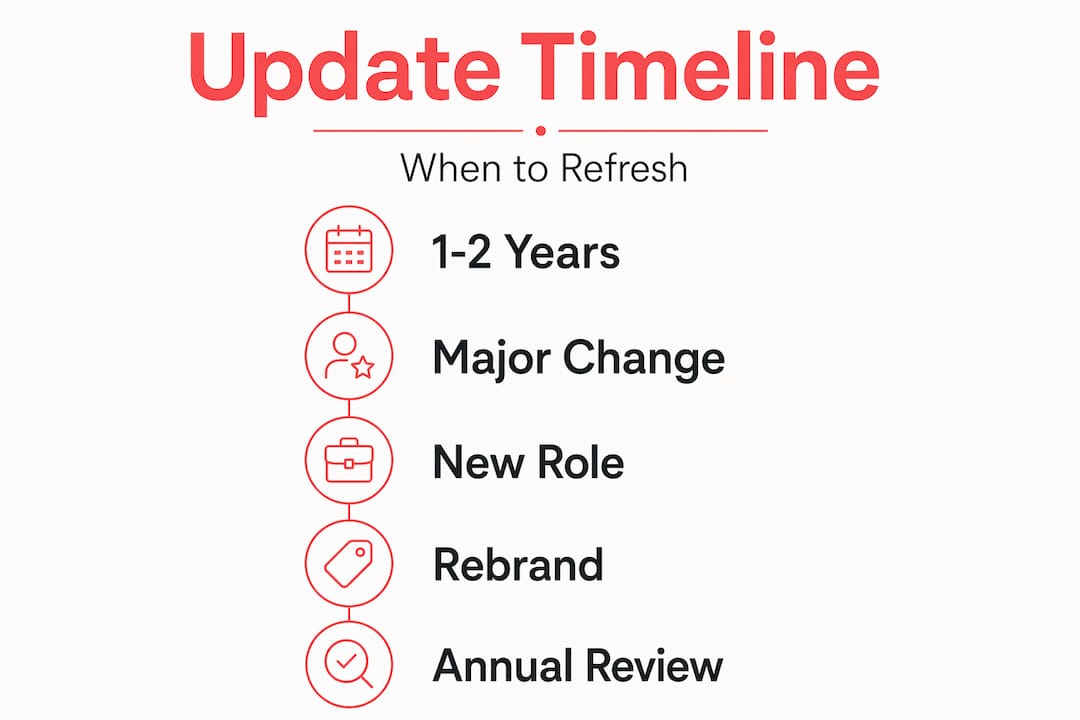
Most branding experts agree that updating headshots every one to three years is a sound baseline. But timelines are only part of the picture. The real question is whether your photo still looks like you, and whether it still fits where you’re headed professionally.
Here are the key triggers that should prompt an update, regardless of when you last sat in front of a camera:
Significant appearance changes. New haircut, different hair colour, notable weight change, or updated glasses all shift your recognisability. If someone meets you after seeing your headshot and does a double-take, it’s time.
Career transition. Moving from a corporate role to entrepreneurship, launching a new consultancy, or pivoting industries each signal a new chapter. Your photo should reflect the professional you are now, not who you were three roles ago.
Company rebrand. If your organisation has updated its visual identity, colours, or tone, your headshot may no longer fit the new look. Consistency between your photo and your brand’s aesthetic is part of the professional package.
New platforms or audiences. Stepping into public speaking, media appearances, or a new market means a wider audience is seeing your face. That’s the moment to invest in a photo that’s fully ready for that exposure.
Photos taken in poor conditions. Low resolution, bad lighting, casual backgrounds, or obvious selfies are a liability no matter how recent they are.
Scenario | Recommended action |
Photo is 1 to 2 years old, no major changes | Review and assess; update if quality is poor |
Photo is 3 or more years old | Update regardless of appearance changes |
Significant appearance change | Update immediately |
Career or brand pivot | Update before promoting the new direction |
Launching a new business or service | New headshot before launch |
Pro Tip: Plan your headshot session around a career milestone: a new job, a product launch, a conference where you’re presenting. It gives the photos immediate purpose and you’ll use them more widely.
Fast-moving industries see visual branding evolve quickly, which means a photo from five or more years ago can feel culturally dated even if you look exactly the same. In technology, creative industries, and professional services, staying visually current is part of staying competitive. The risks of using an outdated photo for too long include mismatched expectations when you meet someone in person, and a subtle but real erosion of trust when your image doesn’t match your current reality.
Your brand evolves. Your headshot should too.
Here’s something that doesn’t come up enough in conversations about when to refresh headshots: your brand story changes, even when your face doesn’t. The way you present yourself to your market shifts as you grow, gain experience, and move toward new goals. An old photo can quietly undermine all of that momentum.

Think of it this way. A consultant who spent ten years in corporate finance and is now positioning herself as an executive coach has a fundamentally different message than she did a decade ago. If her headshot still reads “buttoned-up analyst,” that’s a disconnect that potential clients will feel, even if they can’t name exactly why.
Here are the most common non-appearance reasons professionals find themselves needing new headshots:
Brand tone has shifted. Your business has moved from formal and corporate to approachable and personality-forward. A stiff, distant photo no longer fits the brand voice you’ve worked to build.
Wardrobe and style updates. How you dress is part of how your brand communicates. Updated clothing that reflects your current professional identity sends a more accurate signal to your audience.
Audience expectations have changed. Different markets and client types respond differently to visual cues. A headshot that worked brilliantly for a local client base may not land as well with an international corporate audience.
Platform expansion. Moving onto new channels like a podcast, a YouTube series, or a media column means your face is reaching new audiences. Consistent imagery across platforms reinforces brand recognition, but only if the imagery is also current and cohesive.
The benefits of new headshots here go beyond aesthetics. They’re about alignment. When your photo matches your current brand positioning, everything else you put out into the world feels more intentional and credible. People pick up on coherence without being able to articulate it.
For deeper context on how your headshot shapes corporate identity, it’s worth understanding just how much visual storytelling happens in a single frame.
How to plan and maximise your next headshot session
Knowing you need new photos and actually getting great ones are two different things. Here’s how to approach the process so your next session delivers images you’ll genuinely use for the next two or three years.
Before the session
Define your goal. Are you updating for LinkedIn? A new website? Media appearances? Each context may call for slightly different expressions, framing, or backgrounds.
Research photographers whose portfolios align with your brand’s look and feel. Clean, natural, and professional imagery will serve most business contexts better than heavily stylised work.
Prepare two or three outfit options. Bring the wardrobe that reflects your current professional identity, not your most formal option or your most casual one, unless those fit your brand.
Get a full night of sleep before the session. It shows in the eyes more than anything else.
During the session
Communicate with your photographer about what you need the photos to communicate. A good photographer will guide you on expression and posture, but you’re the expert on your brand. Let them know if you want to look approachable and warm, authoritative and confident, or somewhere in between.
Pro Tip: If you’re nervous in front of a camera, look for a photographer who specifically mentions making sessions low-pressure. The best headshots come out of sessions where the subject is actually relaxed, and that comes from the experience the photographer creates.
After the session
Roll out your new images everywhere at once: LinkedIn, your website bio, your email signature, speaking profiles, and any press materials. Consistent professional imagery across all channels is what builds recognition over time.
For a full breakdown of how to prepare and what to expect, the best professional headshot tips guide at Itsjeffb covers the session process in practical detail. And if you’re not sure whether your current photos have run their course, the signs you need new headshots post is a quick and useful gut-check.
Keeping your professional presentation current doesn’t stop at photos either. Much like updating your CV regularly keeps your career positioning sharp, regularly revisiting your headshot keeps your visual brand honest.
My take: headshots aren’t vanity, they’re strategy
I’ve worked with hundreds of professionals at this point, and the pattern I see most often is this: people wait far too long, and then scramble when they actually need a good photo. A conference speaker finds out they’re on the programme three weeks before the event and suddenly needs a photo that reflects the expert they’ve become. A consultant launches a new service and realises their only usable headshot is from a different career entirely.
What I’ve learned from shooting professional headshots in Calgary is that the professionals who treat their headshots as an ongoing investment rather than a one-time task are the ones who always show up looking like they mean business. They’re not scrambling. They’re ready.
There’s also something I find genuinely fascinating about what a headshot communicates beyond the obvious. The 100-millisecond judgment isn’t just about attractiveness or grooming. It’s about whether someone seems trustworthy, competent, and worth paying attention to. A dated, low-energy photo sends a quiet message that the person in it has stopped investing in how they show up. That’s a message worth correcting.
Updating your headshot isn’t about looking younger or more polished. It’s about making sure the image people see actually matches the professional you are right now. That alignment is what builds trust before you’ve said a word.
— Jeff
Ready to refresh your professional image?
If this article has you looking critically at your current headshot and thinking it might be time, you’re probably right. At Itsjeffb, professional headshot sessions are designed to be genuinely easy and outcome-focused, whether you’re an individual professional refreshing your LinkedIn presence or a business updating an entire team.
[
Sessions are guided, low-pressure, and built around getting you photos you’ll actually use confidently across every platform. From individual Calgary headshot sessions to full team headshots at your office, the goal is always clean, natural imagery that reflects who you are today. Take a look at current session pricing and monthly specials to find the right fit, and let’s get your brand looking its best.
FAQ
How often should you update your professional headshot?
Most branding experts recommend updating your headshot every one to three years, or sooner if you’ve had significant changes to your appearance, role, or brand direction.
Why does an outdated headshot hurt your professional credibility?
An outdated photo signals inattention to your brand and can create a mismatch between how you look in person and how you appear online, both of which erode trust before a conversation starts.
Does a professional headshot actually make a difference on LinkedIn?
Yes. LinkedIn profiles with professional headshots receive up to 21 times more profile views and nine times more connection requests compared to profiles that use informal or no photos.
What triggers should prompt an early headshot update?
Key reasons to update headshots ahead of schedule include a major career transition, a company rebrand, a significant change in your appearance, or an expansion into new markets or platforms.
Does photo consistency across platforms actually matter?
Absolutely. Using consistent professional imagery across your website, LinkedIn, and other channels builds visual recognition and signals that your brand is well-managed and intentional.
Recommended
Comments