Why professional photos elevate your website and brand

TL;DR:
High-quality, authentic images build instant trust and credibility with website visitors.
Professional photos outperform stock and DIY images by engaging users and reinforcing brand consistency.
Local Calgary imagery creates deeper emotional connections and genuine recognition within the community.
Most visitors decide whether they trust your business within seconds of landing on your site, and images carry more weight in that judgment than most Calgary business owners realise. 75% of users judge company credibility based on website design, including whether photos feel professional and real versus generic and disposable. That’s not a small number. Whether you’re a financial firm on Stephen Avenue, a consulting practice in Beltline, or a fast-growing startup in the east village, your photography is doing a job before your words even get a chance. This guide breaks down exactly why professional photos matter, how they outperform the alternatives, and what it means for your brand right here in Calgary.
Table of Contents
Key Takeaways
Point | Details |
First impressions matter | Users evaluate your credibility within seconds, and website images are a key factor in their decision. |
Professional photos outperform stock | Images of real people and authentic moments engage visitors longer and increase trust more than generic stock visuals. |
Brand strength grows with consistency | Consistent, high-quality professional photos support your branding and make you memorable to clients. |
DIY has limits | DIY images may suffice early on, but professional photography is essential as your business scales and competition increases. |
Why first impressions online depend on photography
With the importance of imagery previewed, it’s vital to examine exactly what shapes those crucial first moments when someone lands on your website.
Your website is your handshake. And just like a real handshake, it communicates a lot without saying a word. When a visitor arrives, their brain is already scanning, sorting, and deciding. Is this business trustworthy? Do these people seem credible? Would I feel confident reaching out? All of that happens in one to five seconds, well before a single sentence is read.
Visuals drive those snap judgements. Research from the Stanford Web Credibility Project confirms that professional design and real people images are key factors in perceived site authority. Think about what that means practically: a blurry team photo, an oddly lit headshot taken in a stairwell, or a generic stock image of a person in a suit shaking hands can actually work against you. They signal that your brand hasn’t invested in itself, which makes people wonder why they should invest in you.
There are specific visual factors that either build or break trust in those first seconds. Here’s what’s really happening when someone lands on your page:
Authenticity: Real faces, real environments, and genuine expressions signal that actual humans are behind the brand.
Image quality: Sharp, well-lit, properly composed photos say “we take care of the details.”
Consistency: A mismatched visual style across pages feels disorganised and unprofessional.
Subject matter: Relevant imagery that reflects your actual work or team outperforms decorative filler every time.
Colour and tone: Photos that align with your brand palette create visual harmony and subconscious confidence.
“Professional design and real people images are key factors in how users assess the credibility and authority of a website.” — Stanford Web Credibility Project, via Inkbot Design
Even one or two images that feel off can undermine an otherwise polished site. Visitors might not articulate why they clicked away, but trust had already slipped.
Pro Tip: Audit your own site with fresh eyes. Open it on your phone as if you’re a new visitor. What’s the very first image you see? Does it immediately communicate who you are and that you’re worth trusting? If there’s any hesitation, that’s your answer.
Using professional images for credibility isn’t about vanity. It’s about making sure that snap judgment works in your favour every single time.
Professional photos vs. stock and DIY: What really works?
Having established why visuals count so heavily, let’s look at the options Calgary businesses actually face when sourcing imagery for their websites and marketing materials.
Eye-tracking studies show that real people photos are scrutinised closely by visitors, while stock images are largely ignored. Professional photos guide user attention and increase dwell time. That’s a significant performance difference, and it plays out across every page where imagery lives.
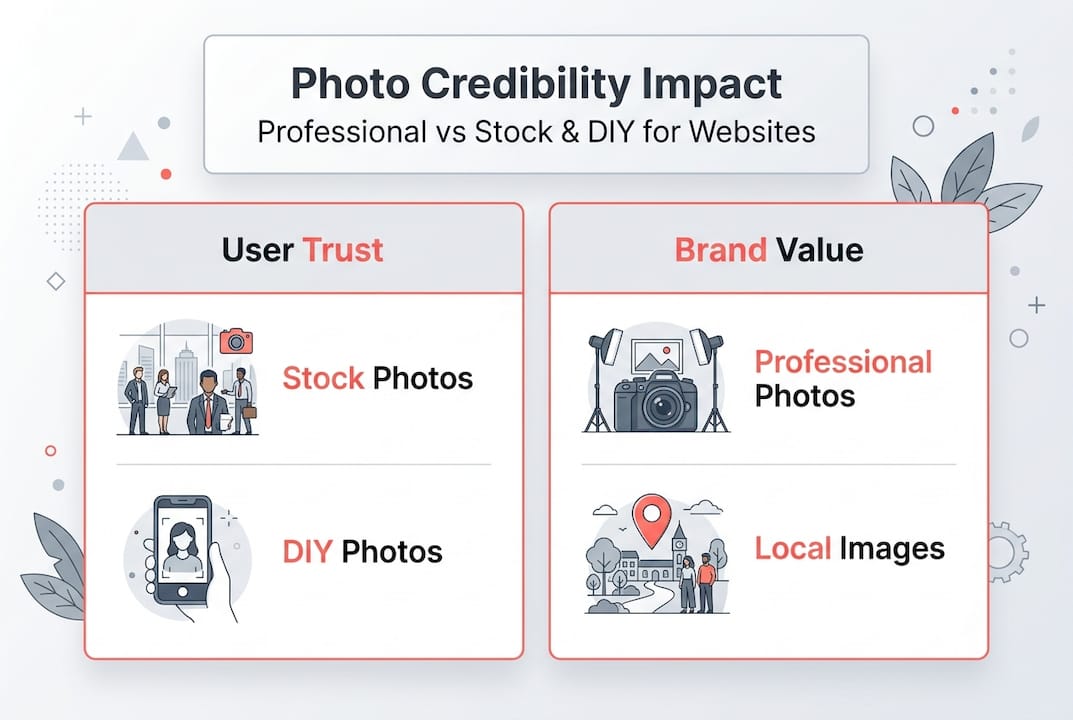
Here’s how the three main options stack up:
Criteria | Stock photos | DIY photos | Professional photos |
Trust factor | Low (feels generic) | Variable (often low) | High (authentic, polished) |
User engagement | Minimal (often skipped) | Moderate at best | Strong (attention-holding) |
Brand alignment | None (off-the-shelf) | Partial (your content, low quality) | Full (intentional, consistent) |
Long-term value | Low (licensed, reused everywhere) | Low to moderate | High (unique, owned, evergreen) |
Cost over time | Recurring subscription fees | Time and equipment costs | One-time investment, lasting return |
The disconnect with stock images goes deeper than aesthetics. Visitors have seen those photos before. They recognise the overly perfect handshake, the suspiciously diverse boardroom, the woman laughing alone at a salad. These images create a cognitive distance. Your site starts to feel like a template, not a real business.
DIY images, especially phone shots taken in whatever light was available that day, often suffer from inconsistency. A team page where every photo looks different in background, lighting, and crop tells a story you don’t want to tell. It communicates that nobody was minding the details.
If you’re thinking about preparing for a business photoshoot or reviewing what business branding imagery can do for your online presence, it helps to start with an honest look at what you currently have.
Here’s a quick audit you can do right now:
Pull up your website’s About page and homepage.
Note every image that features a person. Is it a real photo of your actual team, or stock?
Check whether the lighting, background, and crop style feel consistent across all images.
Imagine seeing it for the first time. Does it feel human, warm, and credible?
Ask a friend or colleague who doesn’t know your brand to give you their honest first impression.
That five-step check often reveals more than a full brand audit. The results are usually pretty telling.
The hidden benefits of investing in professional photography
But the value of professional photography is greater than simply looking impressive at first glance. The long-term benefits reach into brand recall, emotional connection, and even client conversion in ways that most businesses don’t fully account for when they’re weighing the decision.
Professional photos use optimal lighting, composition, and consistency to create emotional connections and visual hierarchy, outperforming stock by engaging users significantly longer. That longer engagement translates directly into more time for your message to land, more opportunity for trust to build, and a higher likelihood that the visitor takes action.
Here’s a comparison of what businesses typically see across a few key engagement areas:
Metric | Stock images | Professional photos |
Average dwell time | Lower (visitors scan and leave) | Higher (visitors explore and engage) |
Brand recall | Weak (generic is forgettable) | Strong (real people are memorable) |
Enquiry/conversion rate | Minimal boost | Measurable uplift |
Social media performance | Flat engagement | Stronger shares and reactions |
Beyond the numbers, professional photography does something subtler. It communicates your values without saying a word. When a potential client sees a team photo that’s well-lit, warmly composed, and consistent in style, they feel something. They sense that this business is intentional. That care and attention show up again in how you handle their project, their question, their invoice.
Consider a Calgary marketing agency that replaces their stock-heavy site with real portraits of their team, photos of actual client meetings, and branded lifestyle shots from around their office. The site starts to feel alive. Visitors spend longer on the About page. Enquiries include more specific references to the team (“I’d love to work with Sarah on this”). That’s the power of real imagery working at full strength.
Here’s what professional photography is quietly doing for your brand every day:
Emotional impact: Real expressions and genuine environments create a feeling of relatability that stock can’t replicate.
Brand clarity: Consistent visual style tells a cohesive story about who you are and what you value.
Dwell time: Engaging visuals slow people down and keep them on page longer.
Trust transfer: A professional, polished look transfers credibility to your services and prices.
Repeat recognition: Distinctive, authentic imagery makes your brand easier to remember across multiple touchpoints.
If you’re exploring the benefits of branded photography or want to think through a complete visual identity guide for your brand, the core idea is the same: your images are working all the time, with or without your attention. Make sure they’re working for you.
When can high-quality DIY work, and when should you go pro?
A common question for businesses, especially early-stage Calgary firms, is whether professional photos are truly necessary right from the start. The honest answer is: it depends on where you are and what you’re trying to accomplish.
Early-stage businesses can use high-quality phone shots initially, but should upgrade to professional photography when scaling trust and conversions becomes a priority. That’s a practical and realistic position. If you’re just getting your MVP homepage live and you’re still validating your offer, a clean, well-lit phone shot in front of a neutral background is better than nothing. No question.
DIY works reasonably well in a few specific situations:
Social proof updates: Quick behind-the-scenes shots for Instagram stories or LinkedIn posts feel natural when they’re not overly polished.
Team updates: When someone new joins and you need a placeholder before a proper shoot is scheduled.
MVP or beta-stage websites: When speed is the priority and the site will evolve quickly anyway.
But there are clear signs that it’s time to invest in professional photography. Here’s when the upgrade becomes less optional and more essential:
Your website is your primary sales tool and you’re losing leads to competitors with stronger visual presence.
You’re raising your rates or repositioning at a higher tier, and your current photos undercut the premium you’re asking for.
Your team has grown and the visual inconsistency across headshots is becoming distracting.
You’re running paid advertising and your creative assets aren’t converting.
You’re preparing for a major pitch, media feature, speaking opportunity, or award submission.
Each of those moments is a signal that your visual story needs to catch up with where your business actually is. There’s often a gap between the quality of the work you’re doing and the quality of how you’re presenting it online. Professional photography closes that gap.
Pro Tip: Even when you’re doing DIY shots, be intentional. Choose a consistent background (a plain wall works beautifully), find soft natural light near a window, and make sure every team member is photographed in the same setting. Consistency matters almost as much as quality.
If you’d like to learn how to take DIY headshots that actually hold up on a professional platform like LinkedIn, there are practical steps that make a real difference, even before you’re ready for a full session.
The scaling journey is real. What works at ten clients doesn’t always work at one hundred. As your reputation grows, so does the scrutiny on every element of your brand presentation. Your photos included.
Our perspective: Why local Calgary images make the best impact
After exploring both the practical and hidden impacts of professional photography, there’s a vital point most guides miss, particularly for Calgary organisations.
Generic is forgettable. It doesn’t matter how sharp the image is or how professional the setup looks if it could belong to any business in any city. What creates genuine connection is specificity. Local imagery, real people, recognisable contexts, and environments that feel true to where you actually operate. That’s what makes someone feel like they’ve found the right fit.
National chains often get this wrong. Their marketing materials look polished but feel distant. Calgary businesses have a real advantage here because you’re already embedded in a community that values authenticity. Showing up with imagery that reflects this city, your team’s actual personality, and the real environment where your work happens builds a kind of trust that no stock library can manufacture.
A professional photo isn’t just about sharpness or good lighting. It’s about communicating, “these are real, relatable people you’ll actually work with.” That’s the message worth sending. When your imagery speaks to your local audience in a way that feels genuine and grounded, it resonates far deeper than anything generic ever could.
You can see Calgary brand examples that illustrate exactly how local, context-aware photography creates a stronger brand impression across every platform where your business shows up.
Elevate your brand with Calgary’s professional headshots
If you’ve made it through this guide and you’re looking at your website with fresh eyes, that clarity is the first step. The next step is doing something about it!
[
At Jeff B Photography, we make professional headshots and branding imagery straightforward and genuinely stress-free for Calgary businesses of every size. Whether you need a single polished headshot for LinkedIn, a consistent set of portraits for your growing team, or a full set of brand photos that bring your website to life, we’re here to make that happen efficiently and with results you’ll actually be proud to use. Check out our Calgary headshots page to see what a session looks like and how simple the process really is. Let’s make sure your website is doing the trust-building work it should be doing every single day.
Frequently asked questions
What is the main advantage of professional photos over stock images for my business website?
Professional photos create trust and authority by showcasing real people and authentic branding, while stock images are often ignored by visitors. As 75% of users judge credibility based on website design, real imagery gives your business an immediate and measurable advantage.
Can I use my phone to take business photos for my website?
High-quality phone images can work for small businesses just starting out, but professional shots become important as you scale. Early-stage businesses can use phone shots initially, but upgrading is key when trust and conversions matter more.
Do professional photos really increase how long users stay on my website?
Yes, real people photos in professional setups genuinely hold attention. Eye-tracking research shows that real people photos are scrutinised closely while stock images are largely ignored, meaning professional photos directly increase user dwell time.
How do professional photos support my overall branding?
They provide visual consistency, reinforce your message, and help customers remember your business across every touchpoint. Professional photos use optimal lighting and composition to create emotional connections and a clear visual hierarchy that stock photos simply cannot deliver.
Recommended

Comments